
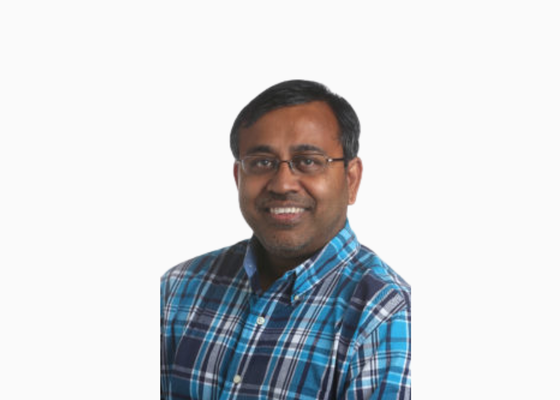
Dr. Rajesh Nandy
Associate Professor, Population & Community Health
Education & Experience:
I received my PhD in Mathematics from the University of Washington, specializing in
the theory of stochastic processes. I completed the MStat degree in Statistics from
Indian Statistical Institute and pursued PhD-level study in Physics. After completion
of my PhD, I was appointed as a Senior Fellow for the Department of Radiology at the
University of Washington to perform research on data analysis methods in neuroimaging
data. Prior to joining the UNT Health College of Public Health in 2013, I served
on the faculty at UCLA as an Assistant Professor of Biostatistics and Psychology.
Teaching Areas & Public Health Interests:
I consider teaching as an important aspect of my career, which perfectly complements
my research career. I am a motivated teacher who is willing to take challenging courses
as well as challenge the students. I enjoy developing new courses and evolving existing
courses. In fact, I had an early head start as a teacher when I was given the opportunity
to teach independent courses in Calculus as a doctoral student at the University of
Washington. Since then, I have taught several graduate and undergraduate courses in
Statistics and Biostatistics, Introductory Statistics, Design of Experiments, Survival
Analysis, Bayesian Statistics, Statistical Methods in fMRI and Multivariate Statistics.
I am a strong advocate for the implementation of modern technology in instruction
at introductory-level large undergraduate courses. I have implemented the iClicker
classroom response system to create a dynamic learning environment in class to great
success.
Professional Activities & Awards:
I am an active member of several professional academic organizations, including the
American Statistical Association, International Society for Magnetic Resonance in
Medicine and Organization for Human Brain Mapping. I had the rare honor of being awarded
the P. C. Mahalanobis Gold Medal – named after P.C. Mahalanobis, founder of the Indian
Statistical Institute – in recognition for being the most outstanding student in my
cohort of MStat students at the Institute. I have also received several travel awards
from the International Society for Magnetic Resonance in Medicine and the Organization
for Human Brain Mapping.
Scholarly Interests:
My primary research goal is to develop novel, intuitive and practical statistical
methods that can contribute to solving real life problems. In fact, the motivation
for most of my statistical methodological research comes from real data where conventional
statistical approaches are either inadequate or fail completely. To accomplish my
research objectives, I actively seek opportunities to collaborate with statisticians
and investigators in diverse research fields.
I have applied my methods to a broad range of applications including clinical trials, neuroimaging, dose response, psychiatry and signal processing using a wide array of statistical methods like Multivariate Statistical Analysis, Receiver Operating Characteristics (ROC) methods, Multiple Comparison, Resampling Methods, Machine Learning, Bayesian variable selection, Optimal Designs and Spatial Statistics.