
PharmD student has life-changing experience with service dog
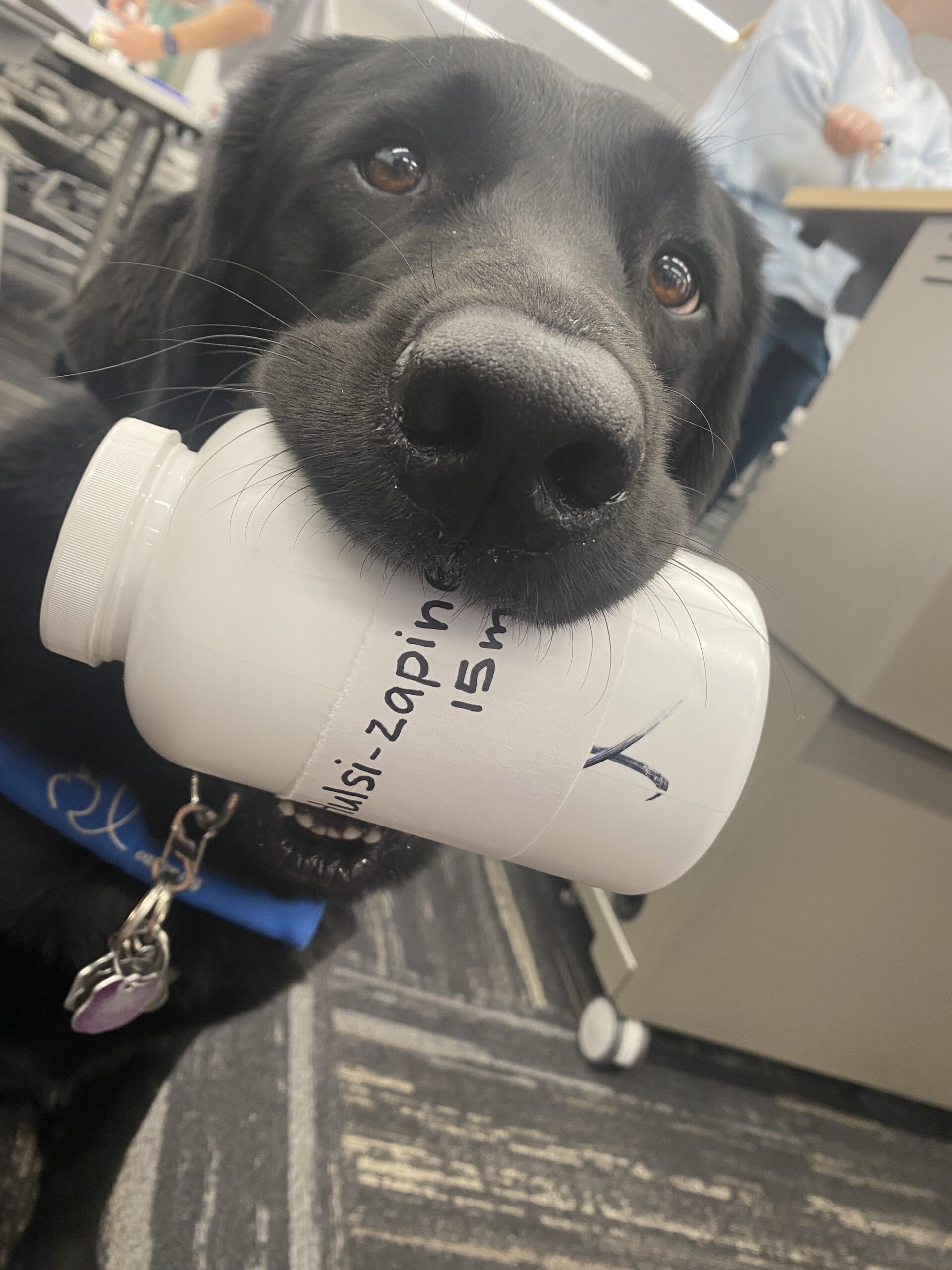 When Elizabeth Brownen suddenly lost all hearing in her right ear during her first
year of college, she couldn’t have imagined that the experience would eventually lead
her not only to a life-changing partnership with “Rock,” a sweet and loyal service
dog, but also to a new direction in her academic and professional life.
When Elizabeth Brownen suddenly lost all hearing in her right ear during her first
year of college, she couldn’t have imagined that the experience would eventually lead
her not only to a life-changing partnership with “Rock,” a sweet and loyal service
dog, but also to a new direction in her academic and professional life.
Brownen, who grew up inspired by her father who is also in the medical field and has always been passionate about animals, had long dreamed of caring for their medical needs. She originally entered college in the pre-veterinary medicine track and her passion for animal care only grew bigger during a summer job as a kennel technician with Canine Companions, a nonprofit that provides service dogs to people with disabilities.
“I worked there for the summer and it was the summer after I lost all the hearing in my right ear, I have had hearing loss almost all my life and then in my freshman year I lost the rest of hearing in my right ear overnight. So I started seeing how these dogs were helping people with different disabilities,” Brownen said.
Surrounded by working dogs and dedicated trainers, she witnessed firsthand the transformative independence these animals bring. It was also there that her coworkers, aware of her recent hearing loss, introduced her to the concept of a hearing dog — something she did not know existed before.
“All the trainers told me they thought I would be the perfect candidate for a hearing dog.”
After receiving a cochlear implant in 2020, Brownen regained much of her hearing but quickly realized how dependent she had become on technology, batteries, hardware and daily maintenance. Despite her hearing improving after the implant, locating the direction of sound remained difficult.
“After I got the implant I started noticing that I could hear, but I couldn’t tell where it was coming from and I can’t always hear everything perfectly. So I put my application in and it usually takes a couple of years to get a service dogs from non-profits like Canine Companions,” Brownen said.
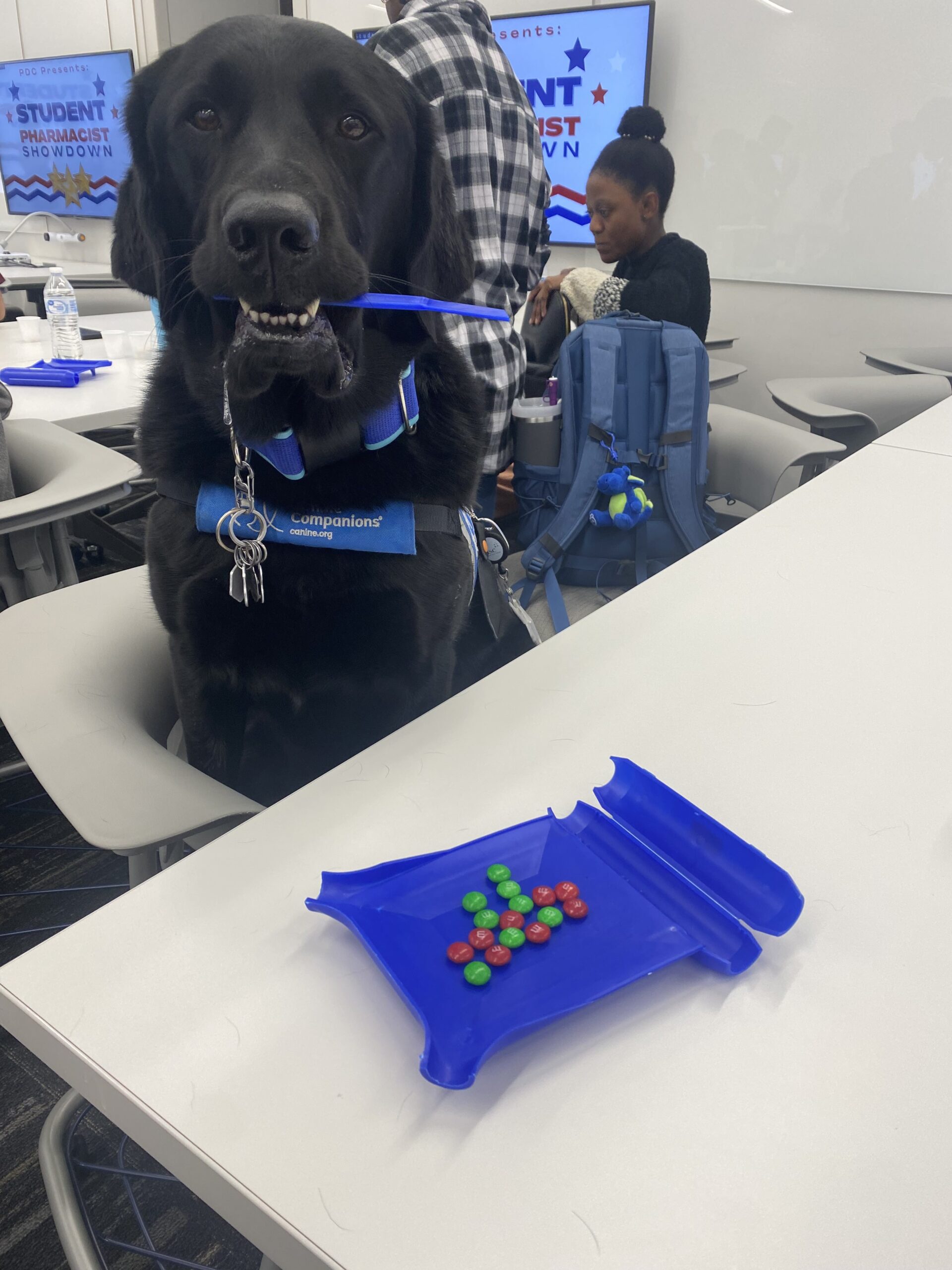 As fate would have it, Rock, had already entered the world on Jan. 31, 2020. Rock
was raised and socialized by volunteer puppy-raisers in Colorado Springs before moving
to Canine Companions’ Oceanside, California campus for professional training. Meanwhile,
Elizabeth underwent a detailed interview process, was approved for the waitlist and
began her long wait for a suitable match for a service dog.
As fate would have it, Rock, had already entered the world on Jan. 31, 2020. Rock
was raised and socialized by volunteer puppy-raisers in Colorado Springs before moving
to Canine Companions’ Oceanside, California campus for professional training. Meanwhile,
Elizabeth underwent a detailed interview process, was approved for the waitlist and
began her long wait for a suitable match for a service dog.
During this time of personal growth and discovery, she also experienced an academic transformation. Her early college years as a pre-vet major gave way to a deepening interest in pharmacy, which was a field she had not initially considered, but soon fell in love with.
“It was kind of a little happy accident. I was sitting in a class and a pharmacy school came in to talk about pharmacy and I was really interested in it, and it kind of made the most sense for my life,” Brownen said. One of the key reasons for this shift was deeply personal.
“My brother was born three months premature and he had to have a lot of medicine compounded for him when he was younger. He had a feeding tube, so all his medications had to go through his feeding tube. So it was something that I have just always seen throughout my life and never considered it until I looked back and it made so much sense to go into pharmacy,” Brownen said.
She found herself drawn to the precision, creativity, and real-world impact of compounding medications, which also tied back to her original goals.
“Compounding is so useful in everyday life and I saw that when I was working in veterinary medicine too, how compounding is so useful for animals,” Brownen said.
Eventually, she was invited to Team Training in Oceanside on June 2022, where she met Rock. She remembers the first time she met the gentle, oversized black Lab/Golden Retriever mix, lovingly nicknamed “black bear” for his size and sweet demeanor. Of the eight available service dogs, she was matched with Rock.
“Once you’re up on the waitlist to get your dog, you go in for a two-week team training and you and all your classmates will go in. You don’t even know what dogs they have available, a golden retriever or lab, a male or a female. The first two days you meet the different dogs they have available and then on day three is when the match happens.”
The matching ultimately is decided by trainers who observe and see which dogs match the applicant better. Elizabeth and Rock officially graduated as a team on June 10, 2022.
 Since then, Rock has made an immeasurable impact on her daily life. He wakes her up
each morning, alerts her to important sounds from alarms to door knocks and dropped
keys, and lifesaving ones such as fire alerts. Rock joins her in every step of the
way through pharmacy school, from the classroom to the lab in full protective gear.
Since then, Rock has made an immeasurable impact on her daily life. He wakes her up
each morning, alerts her to important sounds from alarms to door knocks and dropped
keys, and lifesaving ones such as fire alerts. Rock joins her in every step of the
way through pharmacy school, from the classroom to the lab in full protective gear.
“In my undergrad I used to miss a lot of classes because I used to sleep through alarms. I cannot wear my hearing aid or implant when I’m asleep because it is not recommended,” Brownen said. “There is a lot of anxiety when it comes to me going to sleep because I can’t hear alarms and I’m also a heavy sleeper. Typical accommodations don’t wake me up, so I knew that having a hearing dog would benefit me in that way and honestly in over two years now I’ve missed only one class if that.”
His presence has ensured Brownen never misses class or vital information, and he will do whatever it takes to make it happen.
“He will alert me by nudging me with his nose, he’ll come up and hit me pretty hard with his nose. That’s his way of letting me know there is a sound happening, so that’s enough of a way to wake me up. If you have a giant dog jumping on you, you’re going to wake up,” Brownen said.
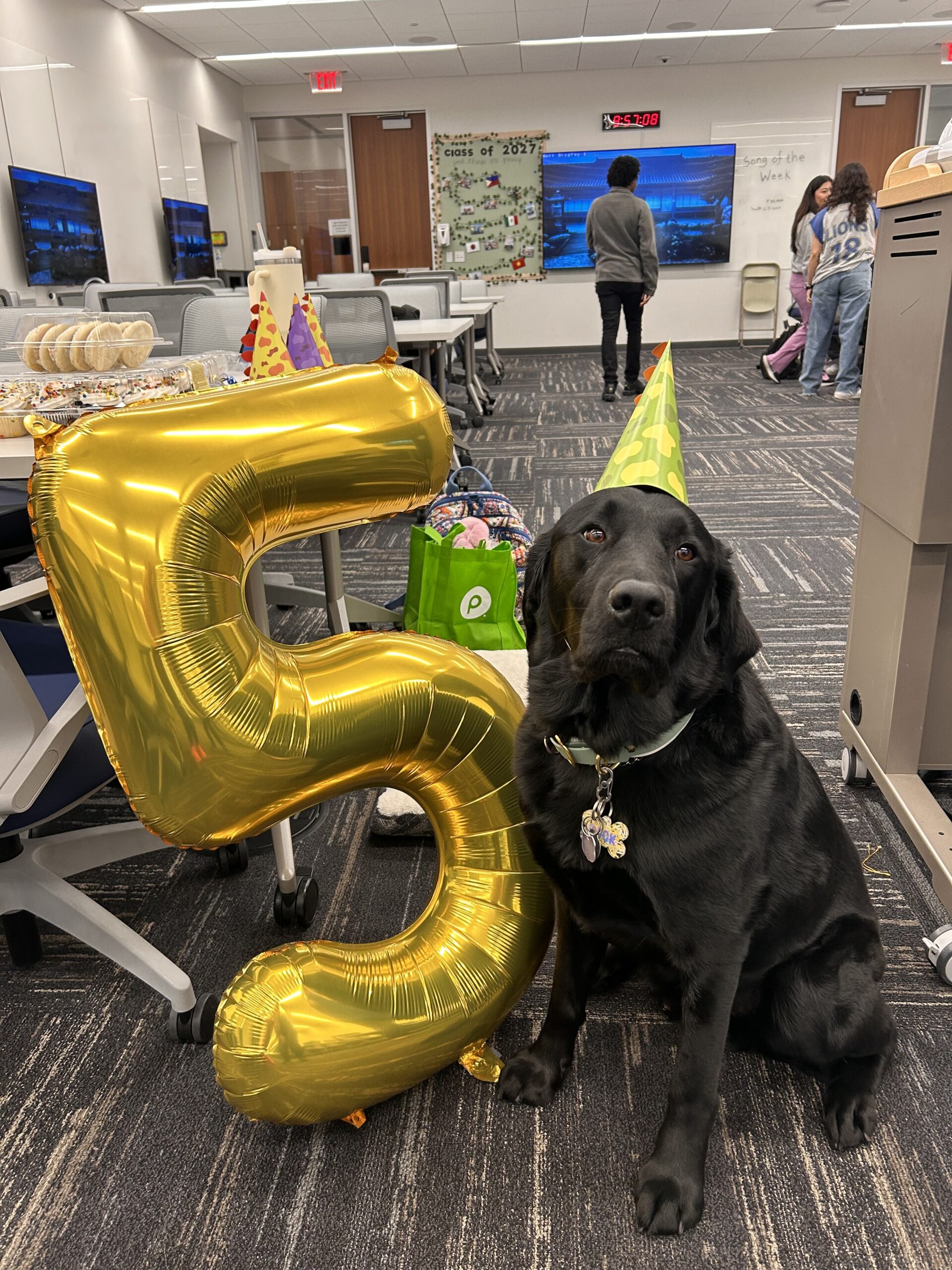 Rock was even inducted into her pharmacy fraternity, Phi Delta Chi, a symbolic but
heartfelt recognition of the integral role he plays in her academic journey.
Rock was even inducted into her pharmacy fraternity, Phi Delta Chi, a symbolic but
heartfelt recognition of the integral role he plays in her academic journey.
“I would say it’s more effort in some areas; I have a dog with me all the time, so I have to be mindful of taking him to the bathroom in between classes, get his lab gear, he needs to eat and all those other things. But it’s been equally as rewarding because he has assisted me with staying focused. If I have a timer that I set to go off, he will get up and alert me so I don’t have to constantly be checking all at once.”
Beyond a support animal, Rock is also a powerful symbol of advocacy and education. Brownen has become a passionate voice in fighting misinformation about service dogs, because stereotypes and misunderstandings about these special furry friends can still prevail.
“I face misconceptions everywhere I go, there is a lot of misinformation out there about service dogs. People think they’re therapy dogs or emotional support animals which are classified differently under the Americans with Disabilities Act.”
Rock is also undeniably a joy to have for everyone he comes across at UNT Health.
“He makes everybody smiles as he walks around and I’ve gotten so many opportunities to educate people about disabilities and service dogs, not just in pharmacy but across campus. It has been an amazing interprofessional experience too. Everybody loves Rock!”
For her, this mission is deeply personal, as service dogs have had an immense impact on her independence and success in life so far.
Brownen speaks openly about the challenges of navigating pharmacy school with a disability, but also about the strong community she has built within the program. One that celebrates diversity, accessibility and perseverance. She also offers an important piece of advice to fellow students with disabilities.
“There is a very small population of those with disabilities who pursue higher education because the world has not been made accessible for us. Mine is just one form of a disability but there are so many different types. Find your tribe, find those people who are able to help take some of the weight off, when captions are not available I’ve had friends who have tried to transcribe what some professors say in real time,” Brownen said.
Her advocacy efforts extend to those not facing a disability as universal design is beneficial for everyone and she raises awareness for everyone to realize that.
“Making something accessible can benefit everybody, that’s actually why text messaging was invented, for the deaf,” Brownen said. “The curve cut theory also benefits everyone, the cuts in the curves on the sidewalk were designed for people in wheelchairs, but when you think about it people with bikes or strollers are all utilizing that.”
Ultimately, pharmacy school has become more than a degree for her, it’s a calling. For Brownen, being in healthcare means more than serving patients, she hopes to lead in educating the system so when a person with a disability enters a clinic or hospital, the providers know what to do to improve those experiences.
“My biggest thing is hoping that pharmacists, doctors, physical therapists, and physical assistants can all benefit to opening their ears and their eyes to groups that are struggling” Brownen said. “This is our patient population, if you think about it a disabled person is more likely to be hospitalized or more likely to go into clinics to seek care and it’s important for providers to be trained in ADA.”
From an unexpected hearing loss to an unexpected change in career path, Brownen’s story is one of adaptability, passion and purpose. With Rock by her side, she’s not just surviving pharmacy school, she is thriving these days. Making her mark on the future of pharmacy, one step and one pawprint at a time.