
Helping amputees live more mobile lives
|
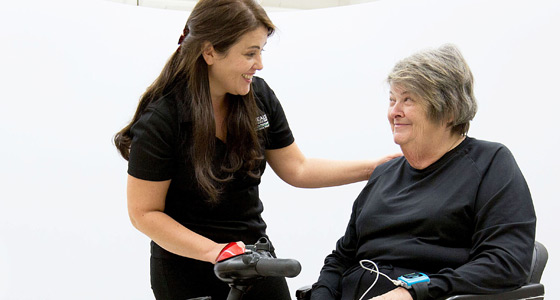
After diabetes took part of her left leg, Jackie Smith, 66, worried whether she would ever regain her mobility with a prosthetic foot that felt stiff and awkward. But her experience wearing a more technologically advanced prosthesis under the eye of Nicoleta Bugnariu, PhD, PT, has the Arlington amputee imagining an independent future. “I can turn easily again and keep my balance,” Smith said. “I was flabbergasted.” Dr. Bugnariu and her team in the Human Movement Performance laboratory are conducting a research study that could improve the quality of life for lower-limb amputees everywhere by changing the way prostheses are prescribed. Early results recently earned an award from the American Orthotic and Prosthetic Association. After an amputation, patients are classified based on their functional abilities. A K2 classification means they have limited mobility, while K3 represents basic to normal mobility. Each amputee is then prescribed a prosthesis that fits his or her classification. A K3 prosthesis is more technologically advanced and expensive than a K2 prosthesis. |
 |
|
Insurance companies only pay for prostheses that match the amputee’s classification. However, Dr. Bugnariu found through randomized trials that increasing the prosthesis worn by amputees – like Smith – from K2 to K3 had an immediate and measurable impact on the amputees’ mobility and quality of life. Increased mobility made the participants less likely to fall or suffer the negative health effects of a sedentary lifestyle. “Right now, it’s a very narrow definition of who can have what prosthesis,” said Dr. Bugnariu, Associate Professor of Physical Therapy at UNTHSC. “The problem is that we are giving less technology and less help to the people who need it most.” Elizabeth Ginzel, CPO/LPO, at Baker Orthotics and Prosthetics in Fort Worth, which recruited participants for the study, said the results show “we have a chance to help people like Jackie become more functional people with more independent lives.” |