
Leading voices in osteopathic medicine
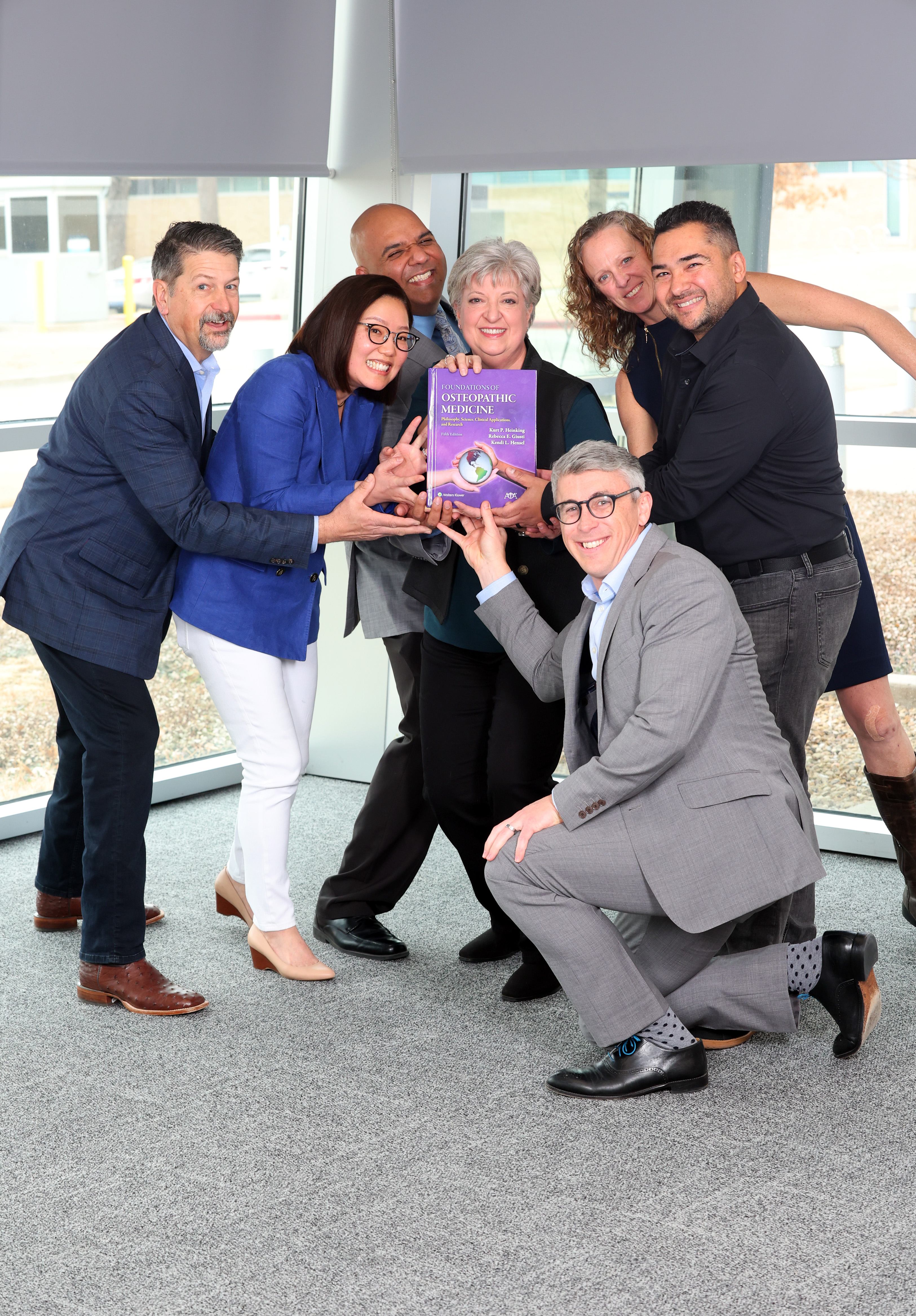 The latest edition of "Foundations of Osteopathic Medicine" — a cornerstone text in
the osteopathic profession — has arrived, and several UNT Health Fort Worth providers
played a pivotal role in shaping it.
The latest edition of "Foundations of Osteopathic Medicine" — a cornerstone text in
the osteopathic profession — has arrived, and several UNT Health Fort Worth providers
played a pivotal role in shaping it.
Led by Dr. Kendi Hensel, co-executive editor and medical director of the Osteopathic Manipulative Medicine clinic at UNT Health, the textbook underwent a four-year revision process to meet the evolving standards of osteopathic medical education. With 23 rewritten or newly authored chapters and 17 updated case studies, the edition reflects both the rapid progression of osteopathic practice and the deep-rooted principles that define the profession.
“This work represents years of collaborative effort to ensure the text remains the gold standard in the field,” Hensel said. “Our goal was consistency, clarity and clinical relevance.”
Hensel, along with co-editors across the country, approached the monumental task one chapter at a time, dividing responsibilities based on expertise and involving a network of trusted colleagues to contribute and review content.
The team met biweekly and maintained continuous communication to ensure cohesion across the textbook’s 13 sections. Key updates were driven in part by the NBOME’s requirement for board exam materials to be drawn from sources no older than five years.
Among the contributions from UNT Health clinicians is a new chapter on Vibration Physiology by Dr. Mindy Hansen.
“We have used percussion hammers in the clinic for a long time, and I became curious about why they work,” Hansen said.
That curiosity led Hansen into a deep dive of international research, uncovering how vibration therapy improves muscle activation, circulation and even wound healing, a valuable tool when combined with OMM.
“It is an extraordinarily potent modality to enhance how muscles are activated,” Hansen said. “Once the mechanical structures are no longer restricted, the vibration makes the brain recruit more muscle fibers to do their jobs better. Once that happens, the patient has much more strength and stability.”
Vibration technology has enormous implications for diabetes, post-surgical healing of wounds, and potentially fractures as well.
Also featured in the textbook is a groundbreaking chapter on Performing Arts Medicine, co-authored by OMM physicians Drs. Yein Lee, Sajid Surve and James Aston. Their work draws attention to the unique needs of performing artists, who rely on peak physical and mental health for their craft.
“Performing Arts Medicine is a natural extension of osteopathic principles, offering a uniquely holistic framework to care for artists whose bodies are both their instruments and their identities,” Lee said. “Ultimately, we hope this chapter encourages DOs to see performers not only as patients but as elite athletes of fine motor control deserving of specialized, empathetic care rooted in the osteopathic philosophy.”
According to Surve, the majority of PAM injuries are related to chronic overuse.
“Performers can be considered ‘small muscle athletes’ as they take tiny muscles that are only meant for periodic use, such as the muscles that wiggle your fingers or control your voice box, and spend hours upon hours using them to their maximum,” Surve said. “We hope this chapter provides a framework for osteopathic physicians to understand and treat this unique and medically underserved population.”
The geriatrics chapter, updated by Drs. Sarah Ross and Janice Knebl reinforced osteopathic care for aging patients, now includes the 4Ms of Age-Friendly Healthcare: mind which includes medication and mood, mobility that includes physical functioning and prevention of falls, medications that includes avoiding high risk medications and deprescribing when possible, and what matters to the older adult and their quality of life.
“At the heart of osteopathic principles and practices is consideration of the whole person and how the body, mind and spirit are so critical to health,” Knebl said. “This type of wholistic and comprehensive approach to health is exactly what older adults need to improve their health and quality of life.”
Dr. Ryan Seals revised the foundational chapter on the Five Models of Osteopathic Medicine. The five models are biomechanical, respiratory-circulatory, metabolic-energetic, neurologic, and behavioral. These are categories that incorporate all the relevant human anatomy and physiology that can help clinicians think through patients’ concerns holistically by addressing the interconnectedness of all the body’s systems.
Seals believes that many physicians misunderstand the model and try to force every idea or consideration into one particular category. The goal, he says, is to promote integration of multiple aspects of a patient’s health, not further divide things into only one category.
“My goal in rewriting this chapter was to portray the usefulness of using the five models approach as a lens to view each person and their condition, while emphasizing the importance of not letting any model distract from viewing the patient as an integrated whole,” Seals said.
In addition to those who edited or authored sections, Dr. David Mason acted as section editor, and Drs. Stephen Fung, Meaghan Nelsen, Christopher Medina, along with resident doctors Ramey Alfarra and Robert Lucas, revised the case studies.
From new approaches to functional anatomy to enhanced case-based learning, the updated Foundations of Osteopathic Medicinetextbook equips students and clinicians alike with practical tools rooted in holistic care. As Hensel notes, “This book bridges the classroom and the clinic—supporting not only academic success, but lifelong learning.”
The result is more than a textbook. It’s a collective vision of osteopathic education, authored by those at UNT Health and beyond, helping to shape its future.