
TCOM’s Dr. Christopher Medina appointed as a National Faculty Chair for C3DO by NBOME
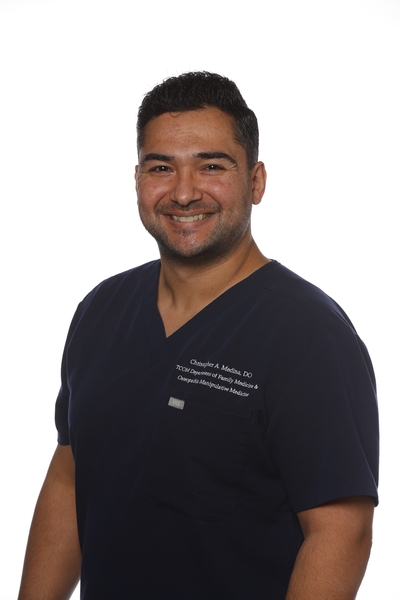 The National Board of Osteopathic Medical Examiners, an independent, nonprofit organization
that provides competency assessments for osteopathic medical licensure and related
health care professions, has appointed Christopher A. Medina, DO, from UNT Health
Fort Worth’s Texas College of Osteopathic Medicine, as a National Faculty Chair for
the new Core Competency Capstone exam. Dr. Medina, who is an associate professor with
TCOM, is the C3DO Examination Chair effective January 2026 and will serve a term of
three years.
The National Board of Osteopathic Medical Examiners, an independent, nonprofit organization
that provides competency assessments for osteopathic medical licensure and related
health care professions, has appointed Christopher A. Medina, DO, from UNT Health
Fort Worth’s Texas College of Osteopathic Medicine, as a National Faculty Chair for
the new Core Competency Capstone exam. Dr. Medina, who is an associate professor with
TCOM, is the C3DO Examination Chair effective January 2026 and will serve a term of
three years.
“I was definitely surprised, but I was very proud of the opportunity and honored that the NBOME would think of me that way and they would see the work we have done here at TCOM and how it can be a model for the rest of the country,” Medina said.
Since 2020, Medina has served on the NBOME National Faculty and has actively participated
in COMLEX Level 1 and Level 2-CE Item Writing and Item Review Workshops. He has served
as the physician lead for the C3DO at TCOM since 2023.
The C3DO program is a national initiative by the NBOME to standardize the assessment
of fundamental clinical skills for osteopathic medical students, replacing the previous
COMLEX-USA Level 2 Performance Evaluation. It is a multi-station Objective Structured
Clinical Examination using standardized patients to evaluate history-taking, physical
exams, Osteopathic Manipulative Treatment, clinical reasoning, and humanistic skills
such as communication, compassion and professionalism. One of the key differences
is that the evaluation will be conducted by osteopathic schools themselves, and students
can take the examination locally, rather than having to travel to a site for the evaluation.
TCOM has played a leading role in developing the C3DO over the past few years, serving
as a pilot site for Phases 2 and 3. The exam will be implemented for the Class of
2029 for schools that apply to NBOME, but it is already a graduation requirement for
TCOM students.
“Over the last three years, the exam has shifted in terms of what the number of cases
would be for the standard assessment,” Medina said. “We had some schools doing four
cases, some doing six, and others doing eight to test the validity of the exam formats,
and it was determined that six cases are the best standard assessment.”
The evaluation will be done at the beginning of the fourth-year for osteopathic medical
students. As the National Faculty Chair of Examination, Medina will help with osteopathic
schools that apply to participate in the C3DO program.
“Right now, there is going to be an onboarding phase where schools apply to participate,”
Medina said. “The NBOME wants to have every school participate in this, but they also
recognize this will take time for all of the schools to adopt this. Part of my role
will be to help schools as they are applying and deciding to participate in C3DO so
we can expand the implementation.”
The COMLEX Level 2 PE was postponed during COVID, and since that time, the osteopathic
community has been working to revitalize a form of practical assessment skills in
students, which is where the C3DO concept was born.
“The C3DO is a six-station standardized patient exam, where the students will have
a 14-minute patient encounter followed by a six-minute post-encounter, during which
they will complete short-answer and multiple-choice clinical decision-making questions,”
Medina said. "They will collect a history, perform a physical exam, and formulate
a diagnosis. In three of the six cases, they formulate a plan that incorporates performing
Osteopathic Manipulative Treatment. Part of the purpose is to ensure that osteopathic
students, as they transition into their roles as physicians, not only have had experience
in a clinical setting, but they also have been assessed and have a validation of their
competency in terms of data collection, humanistic skills, and osteopathic approach
to patients.”
Medina recalls the previous performance evaluation that he himself had to take as
an osteopathic medical student. It was a day-long drive from the farthest end of eastern
Long Island, New York, to Conshohocken, Pennsylvania, for a nerve-racking day of patient
encounters and SOAP (Subjective, Objective, Assessment, and Plan) notes.
“It was difficult, and I remember it was an all-day exam, seeing patients, writing notes, and then driving myself all the way back to the East end of Long Island,” Medina said. “What I would say about this new evaluation, C3DO, is that it’s really going to provide a robust testing experience that will instill confidence in students as they prepare to move into residency training. It will provide an opportunity for them to realize their readiness for residency, and it still keeps in mind convenience and practicality for the students with minimal interruption in their rotation schedule. It will be run by their school to assess the competencies that the school has taught, ensuring students are ready to serve their patients and their community.”