
Nursing associate dean of research prioritizes living bold, saving lives
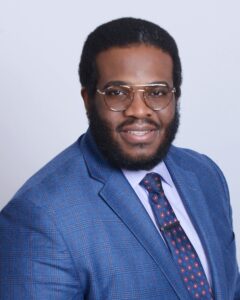 Dr. Tonychris Nnaka’s journey to a career in nursing is one inspired by tragedy and
fueled by his desire to live courageously.
Dr. Tonychris Nnaka’s journey to a career in nursing is one inspired by tragedy and
fueled by his desire to live courageously.
At just 10 years old, Nnaka and his immediate older sister, then age 12, both came down with the same condition – a waterborne illness. Nnaka recovered, but his sister lost her life to this preventable illness.
At the hospital, there was nothing anyone could do.
“Limited resources, delayed care and systemic barriers cost her life,” Nnaka said. “In that moment, I made a promise to myself — one that would guide every decision that followed: Whatever I do, it has to be about saving lives.”
Nnaka is now doing just that as an associate professor and the founding associate dean of research in UNT Health Fort Worth’s College of Nursing.
Changing his perspective
But before making his decision to pursue nursing, Nnaka thought he would become a physician like one of his other sisters. However, when he immigrated to the U.S. from Nigeria, his perspective shifted. He realized he didn’t want to be the person issuing orders from a distance. He wanted to be present — to stand with people in their most vulnerable moments
“Nurses are the constant in healthcare,” Nnaka said. “They are the ones who remain at the bedside, witness the full arc of suffering, healing and humanity. Nursing offered me not just care, but connection — and that changed everything.”
A trajectory for success
Nnaka earned his Bachelor of Science in Nursing at the University of Texas at Arlington. As part of the Honors College, he was paired with the research dean and was the only undergraduate research assistant in his program. This gave him the opportunity to present at conferences and publish research as an undergraduate. He discovered the scientific arm of the nursing profession and quickly realized the profession's vast potential. Nursing is not a career with limitations; it’s a career with endless potential – one that can lead to clinical practice, policy, research, innovation and system-level change.
After completing his bachelor’s degree, Nnaka pursued a Master of Public Health with a dual concentration in epidemiology and environmental & occupational health sciences at UNT Health. While at the academic medical center, he found himself exposed to even more opportunities.
He was selected as Gerry C. Gunnin Public Health fellow by Texas Health Resources headquarters, working alongside executive leadership and contributing to the 2019 system needs assessment. He then was selected as an administrative fellow at the U.S. Department of Health and Human Services Region 6 Headquarters. There, he witnessed firsthand how nurses extend far beyond bedside care to influence population health, emergency response and public policy.
“That experience once again reshaped my understanding of what nursing could be,” Nnaka said.
Back to bedside
Despite his growing knowledge at the system level, Nnaka ultimately decided to return to bedside nursing with a job in critical care and trauma ICU at Parkland Health and Hospital System in Dallas, after completing his master’s degree. At the same time, he pursued his doctorate at The University of Texas at Austin School of Nursing.
Then, in March 2020, everything changed. At a time when little was known about COVID-19 and the first ICU-level COVID patients arrived at Parkland, Nnaka was among the very few nurses who volunteered to care for these critically ill patients.
“It felt like an opportunity to step forward – a moment to step forward with courage instead of fear,” Nnaka said.
And step forward with courage he did. Nnaka became one of the first nurses at Parkland to care for COVID-19 patients. Because of Nnaka’s exposure, he could not go home to his family.
As the pandemic continued to escalate, his background in epidemiology and emergency response positioned him to be a natural leader in his department. Nnaka unofficially became a leader and a sense of calmness for his unit. He helped interpret the rapidly changing information the hospital was receiving about COVID-19 and formulated response strategies – all things that wouldn’t have been possible without his master’s and experience at Texas Health and the Department of Health and Human Services.
When Parkland decided to create an official COVID unit, Nnaka received a well-earned promotion to critical care manager. This is a role that typically takes a decade to achieve, but he earned it in less than two years.
A natural leader
It should come as no surprise that Nnaka’s leadership experience quickly extended beyond hospital walls. During the pandemic, he also transitioned and served as a health policy advisor to the Dallas mayor’s office, working in the ninth-largest city in the country during a critical moment in public health history.
“I was often the only nurse in the room and helped shape COVID vaccine distribution strategies, ensuring vaccines reached the communities that needed them most,” Nnaka said. “One of the highlights of my service was taking vaccines directly into homes in South Dallas – bringing care to people, mostly older adults, who might otherwise have been left behind.”
Another thing he is most proud of is his decision to publicly receive the COVID vaccine during a time of widespread vaccine hesitancy in the Black community.
“It was a moment of skepticism in minority communities about the vaccine,” Nnaka said. “I was reached out to receive the vaccine on national television. I decided to do so. My hope was that if they saw someone who looked like them step forward and get the vaccine, they would too.”
All roads lead back to Fort Worth
Eventually, Nnaka’s career brought him back to UNT Health in September 2023 but this time in a very different capacity. The university had recently announced the launch of a nursing college – something he had previously inquired about as a student at UNT Health. He was now back to help build a new legacy.
When approached about the opportunity to return home and help create the college, he knew he was exactly where he needed to be.
“At the College of Nursing, I found bold colleagues, visionary leadership and a shared commitment to innovation,” Nnaka said. “Together, we built one-of-a-kind nursing practice programs that attract students and employers alike.
“I see myself not as a traditional professor but as a coach — someone who pushes my students beyond comfort and prepares them for the future of healthcare. My classes are demanding by design, grounded in clinical judgment and decisive leadership, because advancing nursing practice and science requires the ability to act decisively in moments where hesitation can cost lives.”
Building his legacy
While Nnaka has already established quite a legacy for himself, he’s not finished yet. His purpose is clear. He wants to transform nursing and the next generation for whatever comes next. He wants the nurses he trains to be bold enough to step forward, confident enough to lead, and willing to learn in real time.
“For me, nursing is no longer just a profession,” Nnaka said. “It is a vehicle for change, a platform for justice and a promise kept — to my dear sister lost too soon and to every life that still can be saved.”
It's In Our DNA
At UNT Health Fort Worth, our students are destined to shape the future of health care, research and public health, and our faculty and staff are here to guide them every step of the way. Whether it’s teaching safe patient care, advancing groundbreaking research or improving community health, it’s all second nature. We were born to live out our mission to create solutions for a healthier community. Why? Because it’s in our DNA. To view more stories, visit our newsroom and select the It's in our DNA category in the drop down menu.