
Stopping the “Silent Thief of Sight”: Why World Glaucoma Week Matters
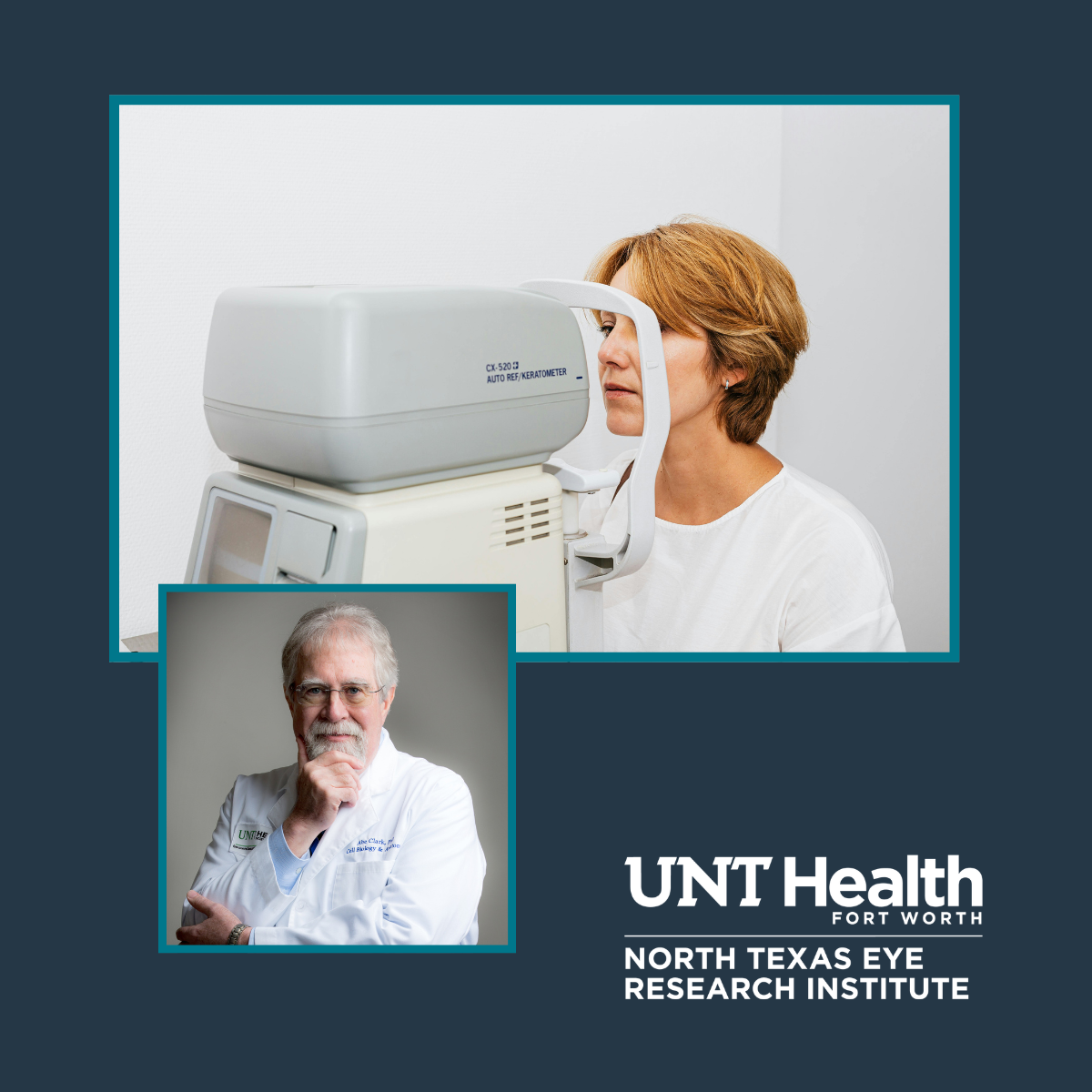 World Glaucoma Week is a weeklong event organized by the World Glaucoma Association to bring awareness
to glaucoma, the leading cause of preventable blindness worldwide. This year, World
Glaucoma Week takes place March 8-14, 2026, with the goal of raising awareness about
glaucoma and urging people to get regular eye and optic nerve checks.
World Glaucoma Week is a weeklong event organized by the World Glaucoma Association to bring awareness
to glaucoma, the leading cause of preventable blindness worldwide. This year, World
Glaucoma Week takes place March 8-14, 2026, with the goal of raising awareness about
glaucoma and urging people to get regular eye and optic nerve checks.
Dr. Abbot Clark, FARVO, is a regents professor in pharmacology and neuroscience at UNT Health Fort Worth in the College of Biomedical and Translational Sciences and NTERI faculty. His research is focused on glaucoma. He gives some insight into this condition, the breakthroughs in how we diagnose and treat glaucoma, and the importance of World Glaucoma Week.
Glaucoma is often called the “silent thief of sight.” Why is that, and what actually happens to the eye when someone has glaucoma?
Glaucoma is the leading cause of irreversible blindness and vision loss in the world, currently affecting 80 million individuals, and that number will continue to increase to 120 million by 2040 and 180 million by 2060. Glaucoma is known as “the silent thief of sight” because this disease is slowly progressive (over decades!) and generally painless. There are regions in the eye that are very sensitive to increased pressure within the eye that damages nerves in the retina responsible for carrying visual signals to the brain. There are several changes to the eye that result in glaucoma, including the tissues that regulate intraocular pressure, the optic nerve head and optic nerve, and the retinal cells (retinal ganglion cells) responsible for carrying the visual signals to the brain via the optic nerve. In addition, the target neurons within the visual centers of the brain also degenerate, making glaucoma a major neurodegenerative disease.
Many people assume they would notice vision changes right away. Why can glaucoma go undetected without regular eye exams?
The vision loss in glaucoma is slowly progressive and not easily noticed. Often, the first visual symptom detected by individuals after years with glaucoma is trouble driving in the dark due to loss of peripheral and night vision. Glaucoma is currently definitively diagnosed using visual field exams. Unfortunately, this current technology is subjective and not very sensitive or accurate. Generally, by the time patients develop reproducible visual field defects, they have already irreversibly lost about 40% of the retinal cells (retinal ganglion cells) that transmit the visual signals from the retina to the brain. However, individuals who have full eye exams annually have a much better chance of catching and treating this insidious disease earlier. There are characteristic structural changes that can be seen and quantified in the retinal and optic nerve head over time, prior to the loss of visual fields. Therefore, the patient may be able to receive therapies earlier in the disease. The major goal of glaucoma therapy is to slow the disease progression to preserve functional vision throughout the patient’s lifetime.
Who is most at risk for developing glaucoma, and at what age should people start having routine optic nerve and eye pressure checks?
One of the major risk factors for the development of glaucoma is age. There is an increased risk of developing glaucoma after the age of 40-45, where 1-4% of the population will develop glaucoma. About 8% of the population over the age of 80 has glaucoma. Everyone should have regular annual vision exams, but it is very important that individuals over the age of 40 get routine annual vision exams that include more than just “eye charts”. Another important risk factor is population ethnicity. Individuals of African descent have a 4-6X greater risk of developing glaucoma with an earlier onset and faster progression compared to individuals of European descent. Likewise, Hispanics have a 2-3X increased risk of developing glaucoma over their lifetime. Individuals of Northern European descent have a higher risk of exfoliation glaucoma, and Eastern Asians have a higher risk of angle closure glaucoma. A third major risk factor is the family history of glaucoma. Although the genetics of most forms of glaucoma are complex, individuals with affected parents or siblings are at 4-10X higher risk for developing glaucoma.
Is high blood pressure involved in the development of glaucoma?
There have been numerous studies on the potential link between systemic hypertension (i.e., high blood pressure) and glaucoma. Unfortunately, there are conflicting data linking high systemic blood pressure with glaucoma, with some studies suggesting an association and others finding no association. This discrepancy is not surprising given that both high blood pressure and glaucoma are common diseases, so there is an overlap of the conditions just by chance. However, several research groups have combined and evaluated multiple clinical trials to see if there is an overall trend between high blood pressure and glaucoma. Combining these published data suggests that high BP has a modest risk of developing glaucoma (i.e., a 16-24% elevated risk of developing glaucoma if you have high blood pressure). In addition, several recent clinical studies also suggest that glaucoma progression is decreased in patients taking drugs to treat high blood pressure. Interestingly, there is a significant risk for glaucoma development and progression in patients with nocturnal hypotension (i.e., low blood pressure at night during sleep). This is due to reduced blood flow to the retina at night, making it more susceptible to glaucomatous damage.
What does a glaucoma screening involve, and how often should people have their eyes and optic nerves examined?
Screening for glaucoma involves several tests. The measurement of intraocular pressure is routinely conducted because elevated IOP is a major causative risk factor for the development and progression of glaucoma. However, this test itself is not sufficient because there are many individuals with “high” intraocular pressure that do not develop glaucoma, and some individuals with “normal” IOPs that do develop glaucoma. Additional instruments can very accurately measure changes to the retina and optic nerve head, and characteristic changes over time accurately predict individuals who will develop or currently have glaucoma. These are routine exams that should be conducted annually, especially for individuals over the age of 40 and who have additional risk factors for developing glaucoma (see above).
If glaucoma is diagnosed, what treatment options are available, and how can early detection help preserve vision?
Early detection of glaucoma is essential for successful treatment. It is easier to halt or slow the progression of glaucoma in the early stages of glaucoma. Unfortunately, as glaucoma progresses, it becomes more difficult to treat. There are numerous treatment options for glaucoma depending on the stage of disease (i.e., the current amount of glaucomatous damage). All current therapies are directed to lowering IOP, since this is a major risk factor for the development and progression of glaucoma. Initial therapy usually starts with topical ocular delivery of pharmaceutical agents; eye drops that are administered 1-2 times daily. There are several different classes of eye drops that lower IOP by various mechanisms. Unfortunately, glaucoma patients respond differently to each class of eye drops, so initial tests are done to find the most effective drug for each patient. Many patients progress to two or more eye drop therapies. Patients who continue to progress are often treated with in-office laser therapies, which are usually very effective at lowering IOP, but have not had sustained effects for more than several years. Finally, surgical intervention may be required to lower IOP. This may involve invasive surgeries or new minimally invasive surgeries. NTERI scientists are working diligently to discover new “disease-modifying” therapies that directly intervene with the ongoing glaucomatous damage to the eyes, which could suppress or reverse the disease process and become new breakthrough therapies for the better treatment of glaucoma.
Why is World Glaucoma Week so important, and what message would you like people to take away about protecting their vision?
World Glaucoma Week is an annual event encouraged by the World Glaucoma Association. It aims to educate people about glaucoma, risk factors, and the need for annual vision exams. More than half of the people in the Western world do not know they have glaucoma. In underdeveloped countries with limited vision care, over 90% are unaware. We must do better to stop this "silent thief of sight."
For more information on NTERI, please visit our website to learn more about eye health and research.