October 2, 2023 • REAP News
 |
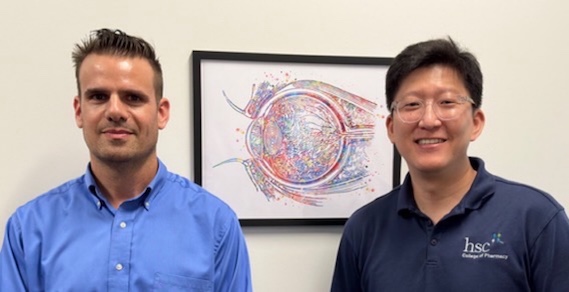
Dimitrios Karamichos, PhD
Jayoung Kim, Ph.D.
“3D-Printed, Personalized Corneal Model as a Topical Device for Improving
Corneal Collagen Cross-Linking Therapy”
For more information about their research, check out this video.
Bios:
Dr. Dimitrios Karamichos and Dr. Jayoung Kim are both faculty members of the Department
of Pharmaceutical Sciences at UNT Health Fort Worth (HSC) College of Pharmacy. Dr.
Karamichos, a Professor and Executive Director of the North Texas Eye Research Institute
(NTERI), has been continuously funded for >10 years by the National Institutes of
Health, as well as other organizations. His research focuses on corneal diseases and
the development of novel therapeutics, with over 80 peer-reviewed manuscripts, and
ongoing service on study sections and editorial boards, including serving as a Chair
of the National Institutes of Health Pathophysiology of Eye Disease 2 (PED2) Study
Section of the Center for Scientific Review. Dr. Karamichos has held academic positions
at the Oklahoma University Health Sciences Center and HSC.
Dr. Jayoung Kim received his postdoctoral fellow training at the Harvard University
after graduating with a Ph.D. in Biomedical Engineering from the Johns Hopkins University
in 2018. His laboratory research focuses on developing advanced carriers for gene
therapy towards precision targeting of diseased tissues. One application is in anterior
ocular disease, for which an engineered cornea-like hydrogel (i.e. contact lens) can
facilitate the delivery of therapeutic agents, including genetic material. Dr. Kim
has published in over 35 peer-reviewed journals and is a recipient of the intramural
Early Stage Investigator Pilot Grant Program.
Current Project: Our project addresses the unmet need in the treatment of Keratoconus (KC), a complication
in the cornea of eye that manifests corneal thinning and outward bulging. Corneal
collagen cross-linking is an FDA-approved KC treatment but not a viable option for
all KC patients, with corneal thickness below 400 μm being one of the reasons for
disqualification due to potential damage of underlying tissue from the UV light during
the procedure. We propose to engineer a protective artificial cornea layer that would
allow sufficient amount of UV to pass through for collagen cross-linking while providing
enough barrier to limit the UV from reaching the underlying tissue. The thickness
of our artificial cornea will be personalized based on the individual patient’s corneal
thickness. State-of-the-art 3D-printing will be utilized for the artificial cornea
fabrication to enable personalization, reproducibility, and scale-up. With Drs. Karamichos
and Kim’s collaborative effort in this Team Science Project, we fully utilize expertise
in both corneal biology and bioengineering, respectively, to develop this innovative
technology.
|
 |
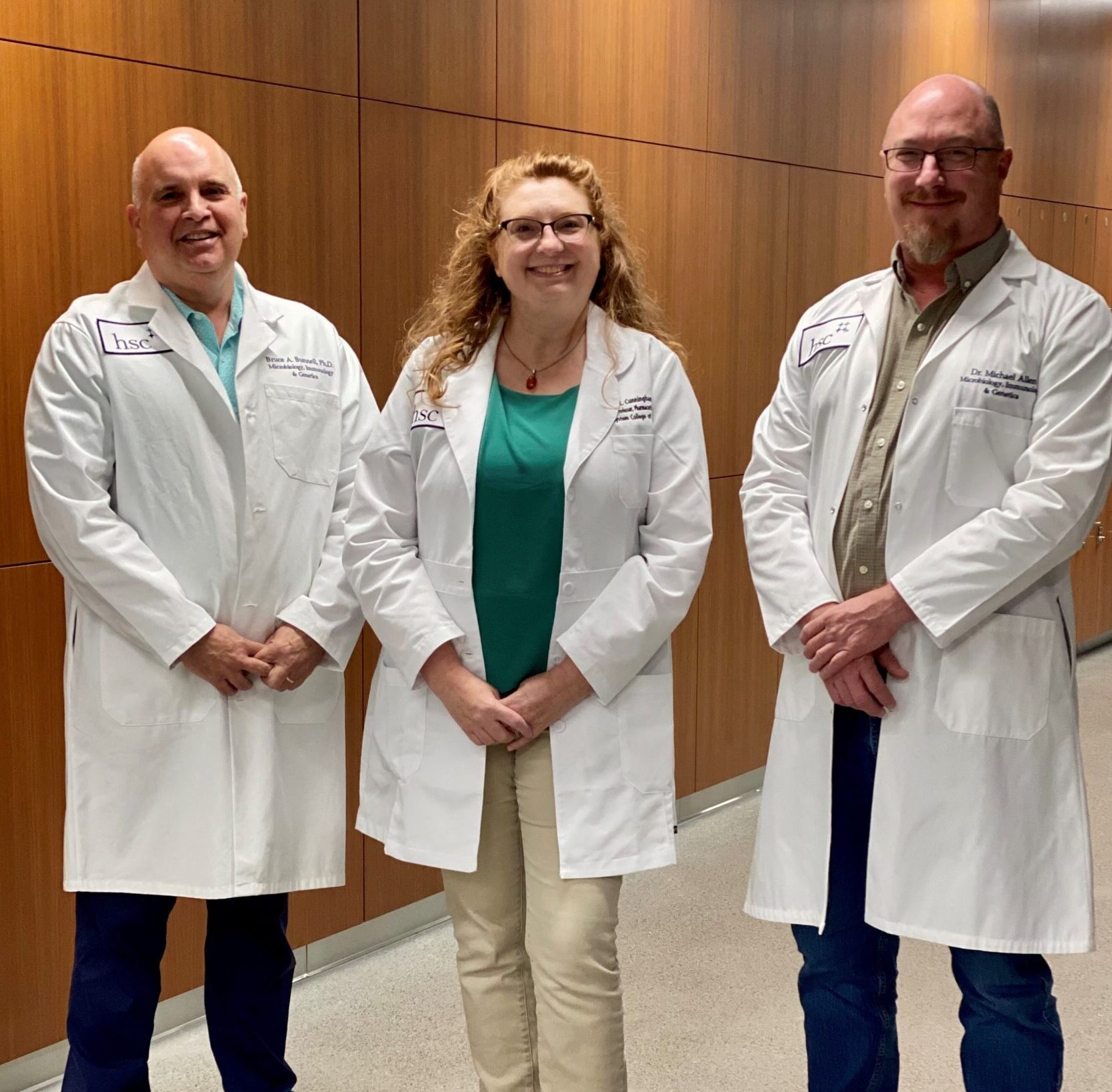
Rebecca Cunningham, PhD
Bruce Bunnell, Ph.D.
Michael Allen, Ph.D.
“The impact of gestational PCB exposure on maternal and fetal
pathophysiology”
For more information about their research, check out this video.
Current Project: Drs. Cunningham, Bunnell, and Allen are examining the impact of ingesting environmental
contaminants, such as methylmercury and PCBS, on maternal and fetal health outcomes.
Food insecurity is high in underserved populations, which increases the risk of consuming
contaminated fish due to urban subsistence fishing. State warnings against fish consumption
vary widely, as each state sets its own advisory limits. It is unknown how maternal
environmental contaminant consumption at levels observed with subsistent fishing impacts
maternal health and fetal development. The goal of our research is to investigate
the mechanisms and toxicological impacts of dietary environmental contaminant exposure
in a rodent model to determine the role of maternal exposure/transfer on neurodevelopment,
along with the metabolic and microbiome systems.
|
 |
Luis Colon-Perez, PhD
David Siderovski, PhD
Kyle Emmitte, PhD
Michael Forster, PhD
“Team-based discovery and preclinical evaluation of cocaine addiction
treatments”
For more information about their research, check out this video.
Bios:
Dr. Colon-Perez’s obtained his PhD in Physics from the University of Florida. His
research focuses on determining in vivo markers of structure and function the brain,
from connectivity in the form of graphs to microstructure in the form of mathematical
models of water diffusion using MRI. Then, he trained as a neuroscientist in the Department
of Psychiatry at UF, where he began to deploy physical models of connectivity and
graph theory to study substance use disorders. In 2018, he joined the University of
California Irvine as a research assistant professor in the Department of Neurobiology
and Behavior before joining UNT Healthin his current role in January 2022. He has
been successful to date with over 40 peer-reviewed articles, two research grants (a
NIDA K25 and a BBRF Young Investigator grant), and several awards (2022 ACNP Jr Faculty
travel award, 2017 MINDS fellow, and 2016 SfN’s NSP fellow); while also mentoring
over 20 undergraduate students.
Dr. Siderovski holds a PhD in Medical Biophysics from the University of Toronto. He
was the first to report the sequencing of a “Regulator of G protein Signaling” (RGS
protein), which is the focus of this team science award.
Dr. Emmitte holds a PhD in Organic Chemistry from the University of North Carolina
at Chapel Hill. His research interests relate to the design and optimization of biologically
active small molecules to serve as drug discovery leads and optimized preclinical
compounds.
Dr. Forster holds a PhD in Psychobiology from Bowling Green State University. He is
Director of the UNT Healthsite for the National Institute on Drug Abuse- Addiction
Treatment Discovery Program (ATDP). His work has evaluated and reported on over 3,000
potential medications for the treatment of drug addiction using behavioral pharmacology
methods of analysis.
Current Project: This team science award begins a collaborative effort between the Department of Pharmacology
and Neuroscience (Drs. Colon-Perez, Siderovski, and Forster) and the Department of
Pharmaceutical Sciences (Dr. Emmitte) to develop and refine RGS12 inhibitor small
molecules for their promise as a first ever pharmacological therapeutic for cocaine
use disorders. This effort uniquely integrates expertise from computational chemistry
(Dr. Siderovski), pharmacology (Dr. Emmitte), rodent behavioral studies (Dr. Forster),
and computational neuroscience and small animal neuroimaging (Dr. Colon-Perez) to
develop and assess in computational predictions of prospective small molecules as
surrogates to inhibit RGS12 function. RGS12 is a negative regulator of kappa opioid
receptor (KOR) signaling. RGS12’s inhibition (by genetic ablation) increases KOR activity,
dopamine transporter (DAT) and serotonin transporter (SERT) expression, thereby reducing
the behavioral effects of cocaine abuse.
|