
Histology
 Histology Core
The Histology Research Core Lab provides high-quality tissue processing and histology services to support biomedical research at UNT Health and beyond. Our state-of-the-art equipment enables precise specimen embedding, microtome sectioning, and slide preparation for a wide range of downstream applications. We offer routine hematoxylin and eosin (H&E) staining, specialized immunohistochemistry (IHC), and advanced resin embedding with ultramicrotome sectioning for high-resolution analysis.
In addition to full-service sample processing, the core provides technician training, consultation on experimental design, and assistance with grant proposals. Researchers may also access shared instrumentation for independent tissue processing and staining. By integrating our services with the Microscopy Research Core, investigators can submit samples and receive high-resolution digital microscopic images through a seamless workflow and rapid turnaround. Pathologist consultation services are also available by referral.
The Histology Research Core proudly supports UNT Health researchers and students, as well as collaborators and investigators worldwide, providing reliable, expert histology services for projects of any scale.
FAQ
Trained users have 24/7 access to Histology Core equipment. Technical assistance is available on weekdays from 8 a.m. to 5 p.m.
Training is provided only to internal users who wish to use the histology core equipment on their own.
Q: What is this about?
A: This is an opportunity to participate in a training session on the Histology Core
equipment.
Q. What kind of training is offered and what are the costs?
A: We offer following training:
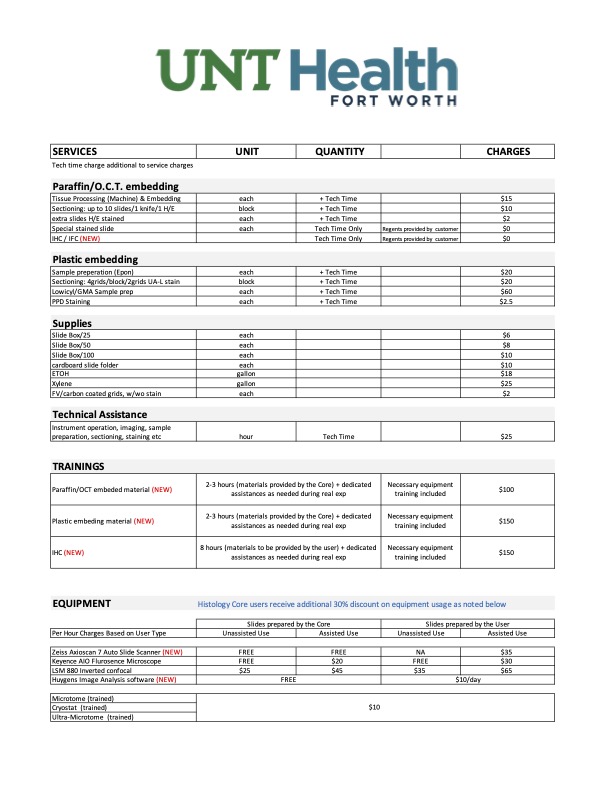
| Trainings | |||
| Paraffin embedded material | 2-3 hours (materials provided by the Core) + dedicated support as needed during real exp | Necessary equipment training included | $150 |
| OCT embedded material | 2-3 hours (materials provided by the Core) + dedicated support as needed during real exp | Necessary equipment training included | $150 |
| Plastic embedding material | 2-3 hours (materials provided by the Core) + dedicated support as needed during real exp | Necessary equipment training included | $150 |
| IHC | 2-3 hours hours (materials to be provided by the user) + dedicated support as needed during real exp | Necessary equipment training included | $150 |
Q: How do I book and make payment for my training?
A: Training is held as per demand. Please contact Tamara McInnis to schedule training and request training using iLab.
To request training through iLab...
- Login with your EUID and Password
- Go to Request Services tab
- Go to Request ?Histology Training? section and Initiate Request
- Fill out the form, complete the payment information and submit
Questions
- Contact Tamara McInnis, Senior Research Associate, Histology
- Contact Sharad Shrestha, Core Labs Director
Open-source image processing and analysis software
- Fiji : A distribution of ImageJ which includes many useful plugins contributed by the community.
- Icy : Used for a wide range of processing and analysis applications.
- CellProfiler : Used for high-throughput image analysis and data mining.
- KNIME : Used for high-throughput image analysis and data mining.
- QuPath : Used for digital pathology and whole slide image analysis.
- ilastik : Consists of powerful machine learning features needed to identify or classify challenging structures.
- napari : It is a fast, interactive, multi-dimensional image viewer for Python. It is designed for browsing, annotating and analyzing large multi-dimensional images.
Bio-image processing and analysis learning resources
- Useful Bio-Image analysis YouTube videos
- Quantifying microscopy images: Top 10 tips for image acquisition
- Quantitative Imaging for Colocalization Analysis
- Avoiding twisted pixels: ethical guidelines for the appropriate use and manipulation of scientific digital images
Bio-imaging Networking
- The Center for Open Bioimage Analysis (COBA)
- The international network of cutting-edge bioimaging facilities and communities: (Exchange of Experience, Training, Shadowing, Working Groups)
Bio-imaging Sample Preparation
Bio-Safety Assessment:
The purpose of the bio-safety assessment is to identify potential hazards, and hence control measures that might be needed. This is to help ensure the health and safety of the researcher and of any other person that might be affected by the work. New researchers are required to submit a bio-safety assessment form during initial consultation
Coming soon...
-
How can I start accessing the Histology Core?
- Email Tamara McInnis to
- Schedule a training with Core staff, get trained and use histology equipment by yourself.
- Schedule sample submission consultation session with Core staff, who will coordinate with you to image your sample.
- Email Tamara McInnis to
- How can I get access to histology instruments after hours?
- Only trained users are authorized to operate instrument independently after hours.
- Who to contact if I have any questions?
- Contact Tamara McInnis
Recommended Sample Submission & Preparation Guideline:
- More information to come
Contributions to scientific output is an important metric for Core Labs, as it enables us to obtain financial and other support to ensure continuous high standards of operations to foster innovative research.
Users are encouraged to acknowledge Histology Core in presentations, posters, papers and all other publications.
For example: "We acknowledge [name of staff] in the UNT Health Histology Core for training and assistance on [following]".
When to acknowledge or provide co-authorship:
- Include an acknowledgement any time the staff member or the Core provides services that support your research.
- If a staff member has made a significant intellectual contribution beyond routine sample analysis, please consider co-authorship.