
A lost voice doesn’t turn into a lost dream: TCOM student overcomes cancer twice to make it to medical school
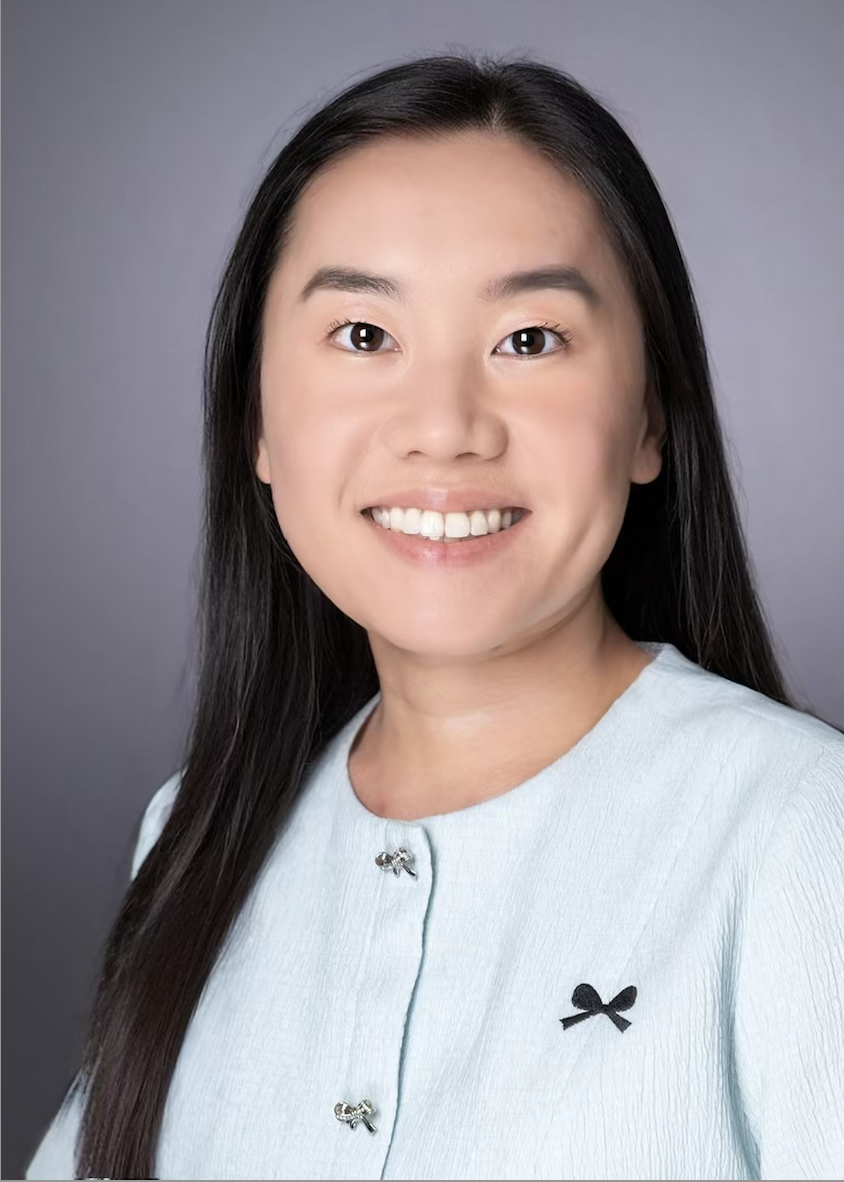 Tiffany Hang woke up to a lost voice one morning in August of 2019, and she was pretty
certain it was just laryngitis, well, probably, but not 100% sure. You see, Hang had
just spent the first four months of the year beating Stage 3 non-Hodgkin’s Lymphoma
and was in remission, or at least she thought she was.
Tiffany Hang woke up to a lost voice one morning in August of 2019, and she was pretty
certain it was just laryngitis, well, probably, but not 100% sure. You see, Hang had
just spent the first four months of the year beating Stage 3 non-Hodgkin’s Lymphoma
and was in remission, or at least she thought she was.
She went to her oncologist, did a CT scan, and waited. At the time, Tiffany had just started back up her studies at TCU for the fall and was visiting with one of her professors when she got a voicemail from her oncology nurse; she needed to come to the doctor immediately.
“I sobbed for hours in my professor’s office, I knew it had come back,” Hang said.
It did come back.
Her battle started nine months earlier, and Hang was faced with the prospect of having to endure more devastating treatments to beat cancer for a second time.
School? That will have to wait. Medical school? Unfathomable. But six years later, Tiffany Hang has started a journey at UNT Health Fort Worth’s Texas College of Osteopathic Medicine that nobody thought was possible, including Tiffany.
Acid Reflux
Hang was like any other college student; she was polishing off her finals in December of 2018 and headed home for the break. However, for a few months, she had some pretty nasty acid reflux symptoms, but didn’t think anything of it. When at home, Hang woke up one morning to night sweats and golf ball-sized lymph nodes.
After a visit to a physician, they sat her down and gave her the potential diagnosis.
“It was either an infection or cancer,” Hang said.
She was immediately sent over to Baylor University Medical Center in Dallas for testing and biopsies. Christmas was spent in the hospital for Hang. New Year’s Day brought the diagnosis, non-Hodgkin’s Lymphoma; there was no time to waste, so she began the New Year with treatment.
“Within hours, I literally started chemo,” Hang said.
She also received a visit from oncologist Dr. Jana Reynolds, who was doing rounds. That visit immediately changed her outlook.
“I was really sad, but she walked in and did something differently than all the other physicians,” Hang said. “She sat on my bed and held my hand, it was very comforting. She told me she understood what I was going through; she also had Hodgkin’s Lymphoma when she was in medical school, and that really motivated me.”
Hang needed the motivation; her treatments were rugged to say the least. She did seven cycles of chemotherapy, which finished in April. By May, she was in remission. The family celebrated her victory with a trip to Disney World. Hang had only missed one semester of school, and her life was back on track.
“I thought my life was back when I found out I was in remission; it was over,” Hang said. “I just have to eat healthy, and I’m on my way.”
No voice
That fateful morning in August, at the time, seemed like the end once again for Hang.
“I was really angry because I was prepared to go back to school, and then knowing I wouldn’t be going back, I was just really upset,” she said.
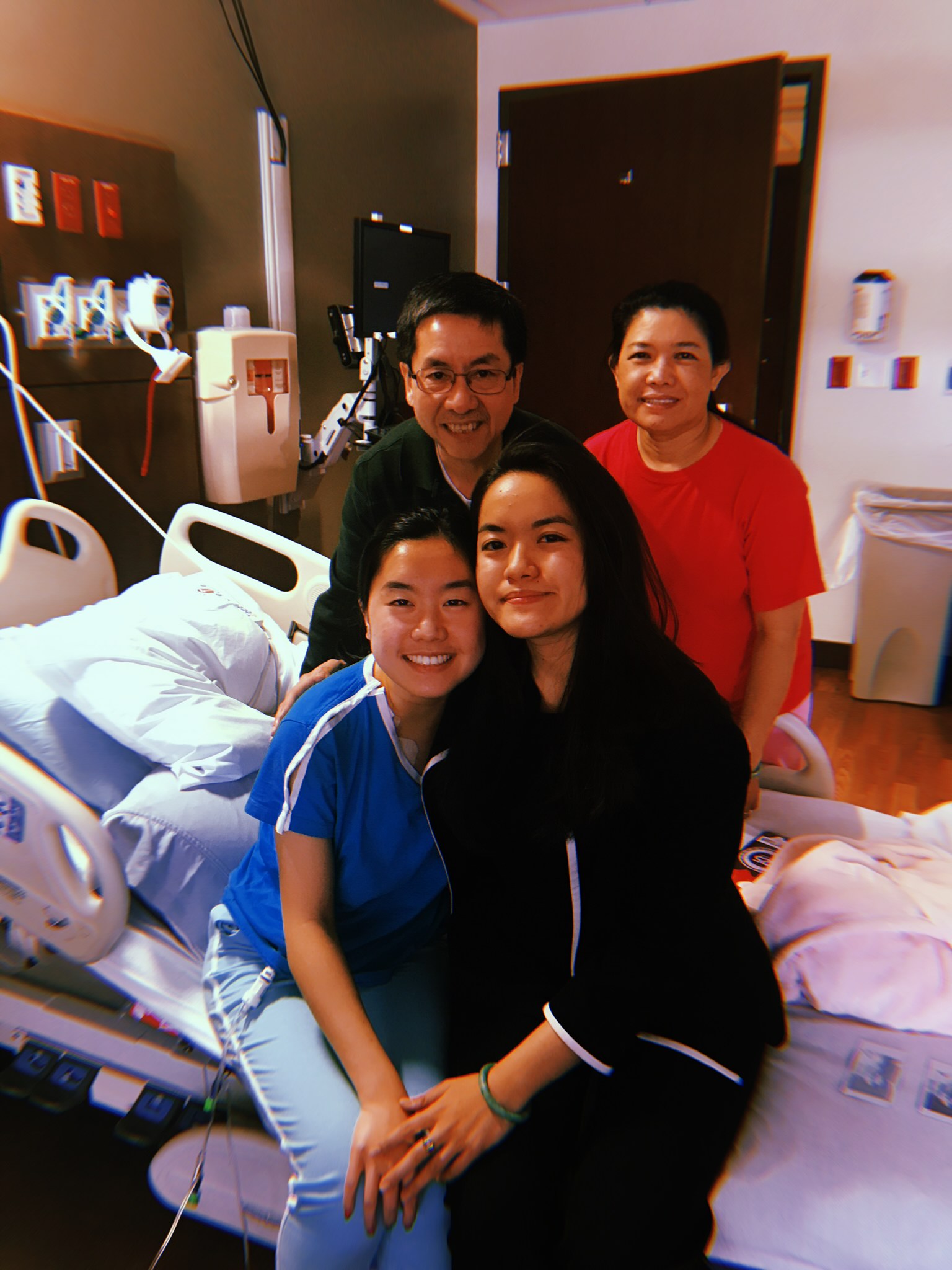 After she visited with Dr. Reynolds, her voice was indeed lost because of the lymphoma,
which had come back. It reached her larynx, and there was also a new, small spot in
her chest. They had caught the cancer early, but it was spreading. She didn’t need
to verbalize her disappointment; it was obvious.
After she visited with Dr. Reynolds, her voice was indeed lost because of the lymphoma,
which had come back. It reached her larynx, and there was also a new, small spot in
her chest. They had caught the cancer early, but it was spreading. She didn’t need
to verbalize her disappointment; it was obvious.
Instead of just taking orders from her doctor, she was given the choice of what to do next.
“She let me take the ropes for what I wanted to do,” Hang said. “I had a few different options, but I opted for a clinical trial.”
Hang was off to the MD Anderson Cancer Center in Houston and given three different clinical trials to choose from. She ended up going with CAR T-Cell therapy, which is a form of cancer immunotherapy that modifies a patient’s own T cells to better recognize and attack cancer cells.
It’s a highly personalized treatment where T cells, a type of white blood cell, are collected from the patient’s blood, genetically engineered in a lab to target cancer cells, multiplied, and then infused back into the patient.
It took eight hours to extract Hang’s T-cells to send off to the lab. Back in Dallas, she now waited for the call to come into the hospital.
“When the call came, we went straight to the hospital,” Hang said. “They injected the cells into me, and my body started reacting. I had fever and chills for literally a week.”
Hang hit rock bottom, but she also saw the silver lining. If things were this bad, it had to mean that it was working. She was right. After not being able to talk and having no voice for three months, it slowly started coming back in November 2019.
After a year-long process, Hang was in remission again; she beat cancer a second time.
Hello, Hello
Hang has a new routine every morning when she wakes up.
“Every time I wake up, I say ‘hello, hello,’” she says with a laugh. “I still have a fear of losing my voice.”
Hang was able to reenroll at TCU in the spring of 2020 and finished her degree in December of 2021, but medical school wasn’t in the cards for her yet.
“I had to be more comfortable that I was going to be cancer-free before I went into medical school,” said Hang.
What was right for her was UNT Health’s Master of Science Medical Science Program. She stepped away from school for a year after graduating and joined the Med Sci program in 2022. Hang graduated in 2023 while at the same time working in cancer community outreach programs in Dallas to help connect patients to cancer resources. She was an advocate already.
“For me, advocating and being there for patients is so important,” Hang said.
It had been nearly five years since Hang was battling cancer, and she decided it was time to apply for medical school. In October of 2024, she got more good news: she was told that she is cancer-free. Months later, she matched into TCOM and was on her way to medical school. Hang had gone from contemplating her own death to achieving her dream.
“If you had told me I would be at TCOM in 2019, I would have told you that you are crazy,” Hang said. “I honestly didn’t think I would ever get into medical school because it was so hard to get good grades in my classes, especially being sick. I thought that track was over in 2019.”
The track wasn’t, and her journey is now beginning. Hang enters medical school with an empathetic edge, having been devastated twice herself.
“It helped me understand what it’s like to be on the other side,” Hang said. “I remember shadowing doctors before cancer and hearing physicians give bad news to patients. It’s so important to be empathetic, and I hope that I can make those patients feel safe with me and give them options for health care, especially as a DO. I want to bring my experiences of being a patient and use them when I start rotations and residency. I will be ready and 100% ready to talk to patients.”
Having done so much already in oncology, it is natural that Hang is already thinking about that as a specialty. She wants to work with cancer survivors, too, and be their advocate. Hang still does a voice check every morning to make sure it’s there, but the weight, the anxiety, and fear she once had have melted away.
“I used to be so stressed about everything, but now I’m like ‘it’s just fine,” she said. “I just go with the flow, and things don’t bother me anymore. I’ve had it much worse.”