
Dr. Kendi Hensel helps shape future of osteopathic healthcare worldwide
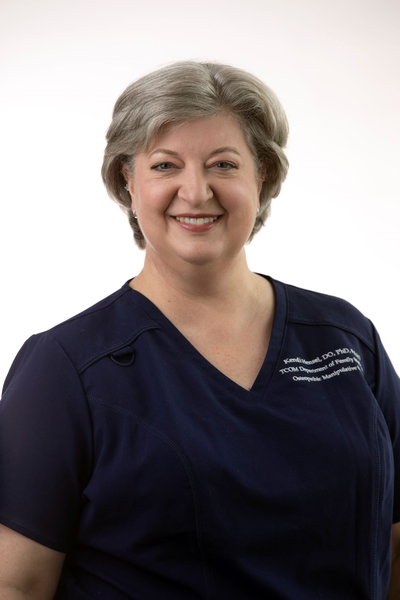
When Dr. Kendi Hensel returned from Geneva, Switzerland in May, there was little time to recover from international travel. She flew home Tuesday and was back in clinic Wednesday, caring for patients at UNT Health Clinical Practice Group.
While the trip itself was brief, the work she was doing could have a lasting impact on osteopathic healthcare around the world.
As chair-elect – of the Osteopathic International Alliance, a non-state actor in official relations with the World Health Organization since 2018, Hensel joined fellow OIA leaders at the World Health Assembly and met with representatives from the WHO's Traditional, Complementary and Integrative Medicine Unit to advance several international initiatives aimed at improving the quality, consistency and recognition of osteopathic healthcare. Hensel will assume the role of chair of the OIA later this year in Paris.
"We envision a world in which every person has access to high-quality osteopathic healthcare," Hensel said. "Regulation and standard setting, both in training and in practice, help ensure that if somebody is putting themselves out there as an osteopath or an osteopathic physician, that there is a certain standard of quality associated with it."
Improving standards worldwide
One challenge facing the osteopathic profession globally is that the term "osteopath" can mean very different things depending on where a person lives.
In the United States, “osteopath” is a historical term used to refer to Doctors of Osteopathic Medicine, who are fully licensed physicians with the same scope of practice as MDs. In many other countries, however, osteopaths are practitioners of manual therapy who do not practice medicine, and who may have vastly different levels of training and regulation.
"In England, osteopathy is very common, highly regulated and covered through the National Health Service," Hensel said. "Then there are other countries where someone could do an online weekend course, hang out a shingle, call themselves an osteopath and start seeing patients."
That variability is one reason the OIA has worked with the WHO for more than a decade to develop international standards for osteopathic training and practice.
The OIA developed a previously adopted WHO benchmark document for osteopathy. Now, the organization is working toward updating that document and adding osteopathic medical practice with the goal of improving patient safety.
"Osteopathic manipulative treatment is a very hands-on skill," Hensel said. "You need good diagnostic skills and enough medical knowledge to recognize when something more serious is happening. If somebody is insufficiently trained and they are presenting themselves as a healthcare provider, they're putting patients at risk."
Discussions in Geneva focused on future WHO technical documents, collaborative projects planned through 2029 and the development of evidence-based resources that can help support healthcare systems and regulators around the world.
Speaking the same language
One of the most ambitious projects currently underway is the development of an International Glossary of Osteopathic Terminology.
While a glossary may sound simple, Hensel said the work has taken years of collaboration among educators, clinicians and professional organizations worldwide.
As the osteopathic philosophy expanded internationally, schools often developed their own terminology and definitions. Differences in language eventually created challenges for education, licensing exams, research and communication between professionals.
The glossary project seeks to establish internationally-accepted definitions for over 100 osteopathic terms.
"When you're creating an international glossary, you have to solicit input from osteopathic practitioners and groups around the world," Hensel said. "We have to be very thoughtful about terminology because we're trying to create international consensus."
The glossary will ultimately be submitted to the WHO as a representation of global consensus within the osteopathic profession.
Measuring a growing profession
The OIA also recently released an updated OIA Global Report, which surveyed member organizations around the world to better understand the current state of osteopathic practice.
Data from the recently released OIA Global Report shows the profession's expanding international reach. Since 2020, the number of countries with osteopathic physicians has increased by nearly 46%, growing to 21 countries worldwide. Osteopathic physicians are now authorized to practice in 57 countries, representing an estimated 171,573 registered practitioners globally. The findings provide an important snapshot of a profession that continues to gain recognition and influence across international healthcare systems.
"The field of osteopathic practice worldwide is growing," Hensel said. "And it's growing because it's a really good approach to healthcare. I think it’s really a statement to the benefit that osteopathy offers to any healthcare system."
The report provides important data for future WHO initiatives and helps demonstrate the profession's global impact.
"For a lot of patients, osteopathy and osteopathic medicine help them avoid surgery and minimize the use of medications while staying functional in their daily lives," she said. “As more patients seek preventative and non-surgical care, osteopathic healthcare will play an increasingly important role.”
Bringing a global perspective to UNT Health
Hensel's involvement with the OIA began in 2022 when she joined the organization's board of directors. For Hensel, this work aligns closely with UNT Health's mission of creating solutions for a healthier community.
"Our UNT Health mission dovetails very nicely with the OIA mission," she said. "The goal is to improve the quality of healthcare providers and with that the overall health of the community."
The international work also has practical implications for UNT Health students and graduates.
Many future physicians are unaware that osteopathy exists outside the United States or that recognition of a DO degree varies significantly from country to country.
"It's important for academic health centers like UNT Health to participate in global healthcare conversations," Hensel said. "If students want to practice internationally or return to their home countries, it's important for us to understand what regulation and recognition look like in those places and how we can support them."
As global collaboration continues and new standards, terminology and evidence-based resources are developed, Hensel believes the profession is moving steadily toward its long-term vision.
"There are large parts of the globe that don’t have osteopaths," she said. "But where the profession exists, we're making progress. I feel encouraged that we may eventually achieve the goal that every person has access to high-quality osteopathic healthcare."