
UNT Health Fort Worth’s first nursing innovation cohort prepares ‘change makers’ in healthcare
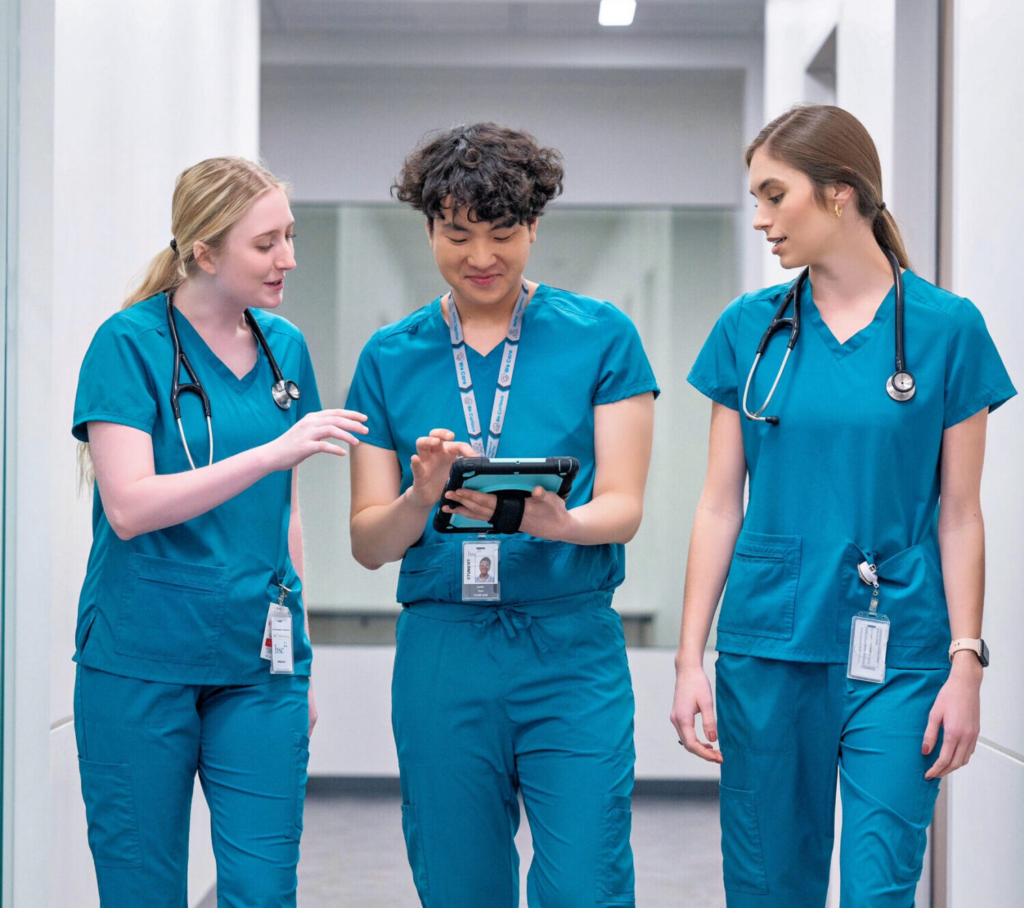
The Master of Science in Nursing Practice Innovation program is preparing to graduate its first cohort of 16 students this month.
At UNT Health Fort Worth, a new kind of nursing graduate is emerging — one trained not only to care for patients, but to rethink how care is delivered.
The Master of Science in Nursing Practice Innovation program, the first of its kind in Texas, was created to prepare nurses to tackle increasingly complex healthcare challenges through creativity, leadership and real-world problem-solving. Now, its first cohort of 16 students is preparing to graduate.
“We have so many healthcare challenges, and they’re only getting more complex,” said Nancy Downing, PhD, RN. “We need nurses who can think differently, try new things and have the skills to do that.”
Unlike traditional Master of Science in Nursing programs, which focus on clinical practice, education or leadership, the innovation track emphasizes design thinking. This human-centered approach that equips nurses to solve problems in real time, even when existing research or solutions don’t yet exist.
 For Sarah Clark, a nurse of 17 years and team leader on a neurology-cardiology unit,
the program has transformed how she approaches challenges in her work.
For Sarah Clark, a nurse of 17 years and team leader on a neurology-cardiology unit,
the program has transformed how she approaches challenges in her work.
“This program has given me the language and the tools to solve problems in a more structured way, not just quick fixes, but solutions that can make a broader impact,” Clark said.
Her capstone project focuses on a device designed to prevent feeding tubes from being accidentally pulled out in pediatric patients, a common issue that can lead to repeated hospital visits and added strain on families and providers.
“Within six months, one patient had to come back three times because the tube kept getting pulled out,” Clark said. “That means ER visits, overnight stays and a lot of stress for families.”
By introducing a breakaway connection that detaches before the tube is pulled from the body, Clark hopes to reduce unnecessary procedures, improve patient comfort and ease the burden on healthcare teams.
Other students in the program are tackling challenges across the healthcare system, often rooted in their own lived experiences and professional backgrounds.
 For Noura Farih, a registered nurse and clinical operations coordinator for a healthcare
startup, that inspiration came from her own family.
For Noura Farih, a registered nurse and clinical operations coordinator for a healthcare
startup, that inspiration came from her own family.
Her capstone project uses artificial intelligence to help patients better manage Type 2 diabetes, particularly those in immigrant and rural communities who often face barriers to care.
“There’s so much information about diabetes, but it’s not reaching the people who need it most,” Farih said.
Her solution builds on continuous glucose monitoring technology, using AI to translate complex health data into personalized, culturally relevant guidance. The tool is designed to communicate in multiple languages and formats — including text, visuals and voice — to meet patients where they are.
Farih said the idea was shaped by watching her mother navigate diabetes care in a system that didn’t always account for language, culture or accessibility.
“You can give someone all the information, but if they don’t understand it or feel comfortable using it, it’s not going to stick,” she said.
By identifying patterns in a patient’s daily habits — from sleep and diet to activity levels — the tool can offer real-time suggestions tailored to their lifestyle, helping patients take a more active role in their care.
Beyond the technical skills, Farih said the program has also changed how she sees herself within the healthcare system.
“This program made me realize I can lead in healthcare, that I don’t have to ask permission to be in these spaces,” she said.
 Brian Pfahning, a flight nurse and manager of education for CareFlight, is applying
a similar innovation mindset to training the next generation of emergency clinicians.
Brian Pfahning, a flight nurse and manager of education for CareFlight, is applying
a similar innovation mindset to training the next generation of emergency clinicians.
Drawing on his background in both healthcare and law enforcement, Pfahning’s work centers on preparing providers to respond effectively in high-stakes situations, particularly in rural areas where access to training can be limited.
His capstone project focuses on integrating virtual reality into clinical education, allowing providers to participate in immersive, scenario-based training without needing to travel.
“The goal is to train clinicians to make the best decisions in the worst situations so patients have the best possible outcomes,” Pfahning said.
While initial plans to implement the technology were delayed due to budget constraints, Pfahning shifted his approach by developing the curriculum and infrastructure needed to support virtual reality training when resources become available.
“Innovation teaches you that a ‘no’ isn’t the end. It just means finding a different way forward,” he said.
That adaptability, he said, is central to the program’s impact — helping nurses think beyond immediate solutions and consider how changes can scale across systems.
Program leaders say that kind of thinking reflects a broader shift in healthcare, where innovation is becoming essential to improving patient outcomes and addressing system-wide challenges.
As hospitals and health systems increasingly invest in innovation roles and departments, graduates of the program are expected to step into leadership positions — bringing new ideas, new perspectives and a willingness to challenge the status quo.
“We’re preparing nurses to be change makers,” Downing said. “People who will lead innovation in their workplaces and reshape how healthcare is delivered.”