
From the rural outskirts of Vietnam to Fort Worth, how a TCOM student is striving to be a physician
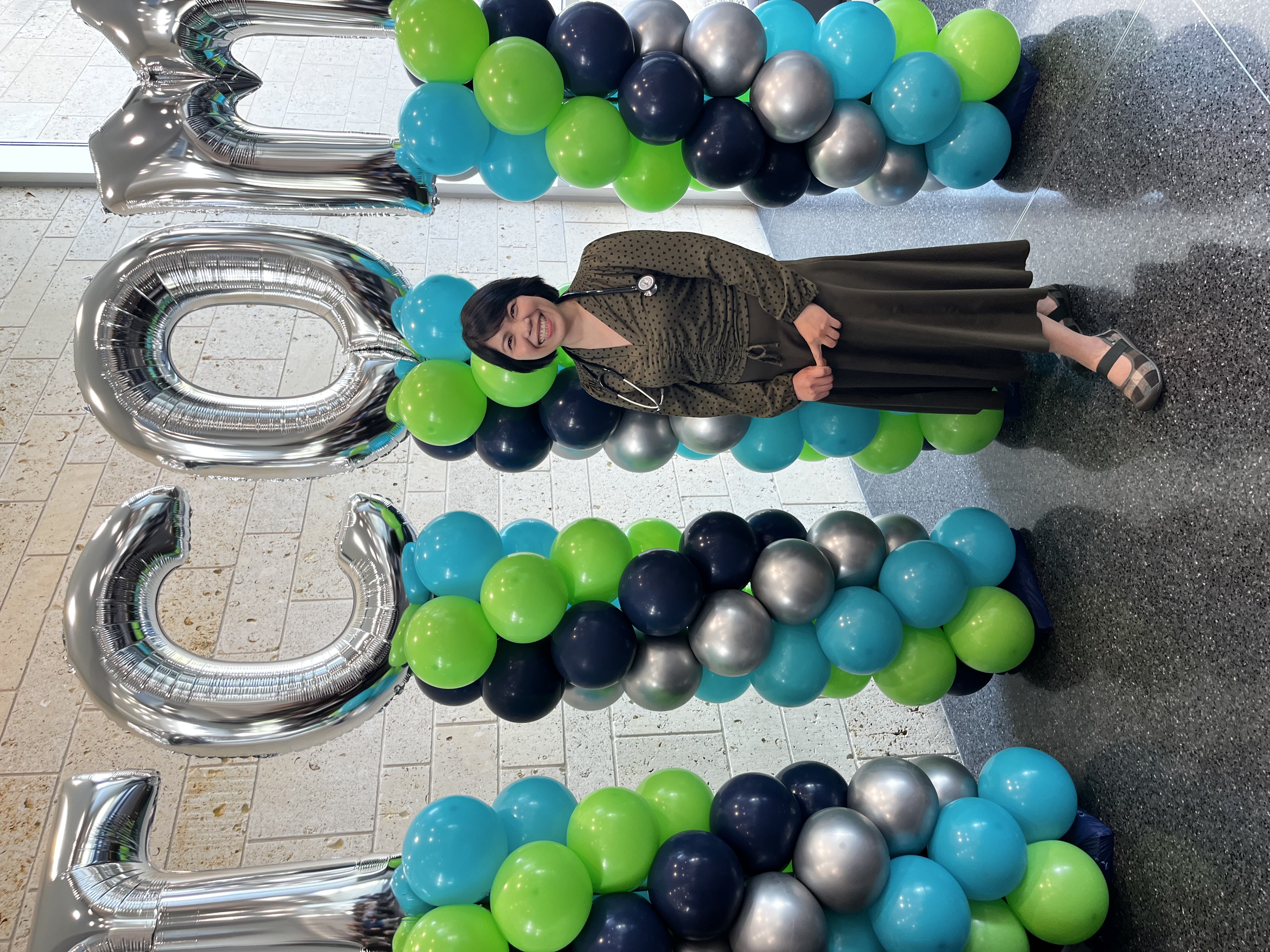 Dr. Lanchi Pham exhaled just a bit after finishing her first week of medical school.
“It’s a lot more work than I thought,” she said.
You read that right: Dr. Pham just started her first week of medical school at UNT
Health’s Texas College of Osteopathic Medicine. Pham is not your traditional student
by any stretch of the imagination; in fact, she’s already a physician, having graduated
from medical school in Vietnam 15 years ago and spent four and a half years practicing
medicine in Ho Chi Minh City. Pham followed her dream once, then her family and now
her dream once again to practice medicine.
Pham grew up in a small town in the Mekong Delta, a floodplain area, in Southern Vietnam,
and by the age of 10, she knew what she wanted to do.
“I wanted to be a police officer,” Pham said, laughing.
She wanted to help others, but it was a tragedy that struck her family that changed
her trajectory. Her father suddenly passed away from a heart attack and Pham changed
her mind.
“With the sudden death of my father, I changed my mind,” she said. “I wanted to become
a doctor to help others and take care of my family. We lived in a very small town
and were far away from hospitals and emergency services, so when my father had symptoms
and almost died in bed, we could not do anything for him. There were no doctors or
nurses around to help him.”
Medical schools operate differently in Vietnam than in the United States. After graduating
high school, Pham went straight into medical school at Can Tho University of Medicine
and Pharmacy. Pham completed six years of medical school and then entered an infectious
disease residency at a hospital in Ho Chi Minh City. In addition, she spent a year
in Japan and earned a Master's in Tropical Medicine from Nagasaki University. Pham
was a physician who began practicing medicine in Ho Chi Minh City, the economic heart
of Vietnam.
There was one thing Pham always knew would happen, though: she would move to the United
States.
“During my medical education in 2008, my mom and siblings moved to the U.S. and from
that moment I knew I would follow them,” Pham said. “Despite knowing my future, I
still finished everything in Vietnam, and many were surprised that I kept going because
they knew I would have to start again, but it gave me knowledge and experience. I
was able to participate in medical mission trips and I saw many patients who received
no healthcare services. It reminded me of my father, and it showed me that the healthcare
system in rural areas in Vietnam is inefficient.”
Pham readily admits that she still “loves Vietnam,” but in 2017, she packed up and
moved to the United States to be with her family. Pham followed the advice from a
Vietnamese surgeon who gave her the pathway to go down when restarting her education
in America. While the idea of having to start from scratch seemed daunting, Pham has
always had a growth mentality and the opportunity to learn new things was exciting.
“I would learn things I didn’t learn in Vietnam and see things I did not see,” she
said. “I was determined to improve my expertise and grow in my abilities to advocate
for the healthcare system and keep myself useful. I felt my opportunities for professional
development were limited, so I hoped to continue my training in a different environment.”
So, despite having doctoral-level training, an MD from a medical school, and a Master’s
in Tropical Medicine, Lanchi Pham went back to school. She first earned an associate's
degree from Lone Star College in 2021 before moving on to The University of Texas
at Austin. There, she majored in biology, and it was then that she had her eyes opened
to what she didn’t learn in Vietnam.
“It was difficult to start over, but I loved it,” Pham said. “I learned things I never
learned before and got hands-on experience at UT that was so valuable and gave me
the chance to grow. The undergraduate program in the U.S. is very unique compared
to Vietnam. We do not have the equivalent and everything I learned in the U.S. in
the undergraduate program is novel to me. The experience and learning skills I had
from Vietnam, I applied those skills in the undergraduate program in the U.S.”
Pham graduated from UT in 2023, but had a few hurdles to clear before applying to
medical school. Her gap years were filled by studying for the MCAT and working in
the medical insurance business as an interpreter. She had the opportunity to volunteer
at TIRR Memorial Hermann/The Institute for Rehabilitation and Research in the Texas
Medical Center, but finding a permanent position, despite having multiple degrees,
a master’s and a medical degree from Vietnam, didn’t open any doors.
Arriving at TCOM as a doctor is a mixed bag for Pham for multiple reasons. One is
the reactions it might bring about, and second, the pressure it places on her.
“I rarely tell people I’m a medical doctor,” Pham said. “There are two kinds of reactions.
Some will feel threatened, but I’m in the same position as everyone else. We have
to do the same exam, and I might have an advantage because of my experience, but for
me that is a kind of pressure. If I don’t perform well and the others know that I’m
a physician in Vietnam, they will think that ‘oh, she’s not good at all, she’s not
smart’, so it’s difficult to navigate.”
Pham has already taken note of some of the differences in medical education between
the two countries.
“In Vietnam, when I was in medical school 15 years ago, students had to figure a lot
of things out on their own,” she said. “If they fail an exam, there is no one to help
them, no Center for Academic Progress, no TAs. We have to figure it out.”
Her motivation has remained steadfast throughout her entire journey to the United
States. To be able to take care of family, advocate for a better healthcare system,
and find a way to bring access to those who don’t have it, so they don’t suffer the
same fate as her father did. Pham isn’t taking any shortcuts. Her interest in specialties
is interventional radiology for multiple reasons.
“It was among the exams I did really well in medical school the first time,” Pham
said with a laugh. “I didn’t choose to go into it at first because it felt isolated.
I’m not interacting with patients when we go to radiology, but I want to do a fellowship
for interventional radiology.”
Her family is in Houston, and Pham returns when she can, but what about Vietnam, her
home before coming to the United States?
“I will practice in the U.S.,” she said. “If I went back to Vietnam, it would be to
go back to improve the healthcare system. I don’t think the medical education or the
healthcare system in Vietnam is bad, but it has weaknesses in the system, and I want
to gain some abilities to advocate for improvement.
“I hope someday I can open a clinic in the rural or mountainous areas of Vietnam.”
By the time she finishes medical school for a second time and a second residency and maybe even a fellowship, in total she will have accumulated anywhere between 13-15 years of medical education. For the little girl who wanted to find the right path to help others, Pham just took a little longer to find it.