
Wise beyond his years, TCOM student has served his family, country and now is ready to serve his community
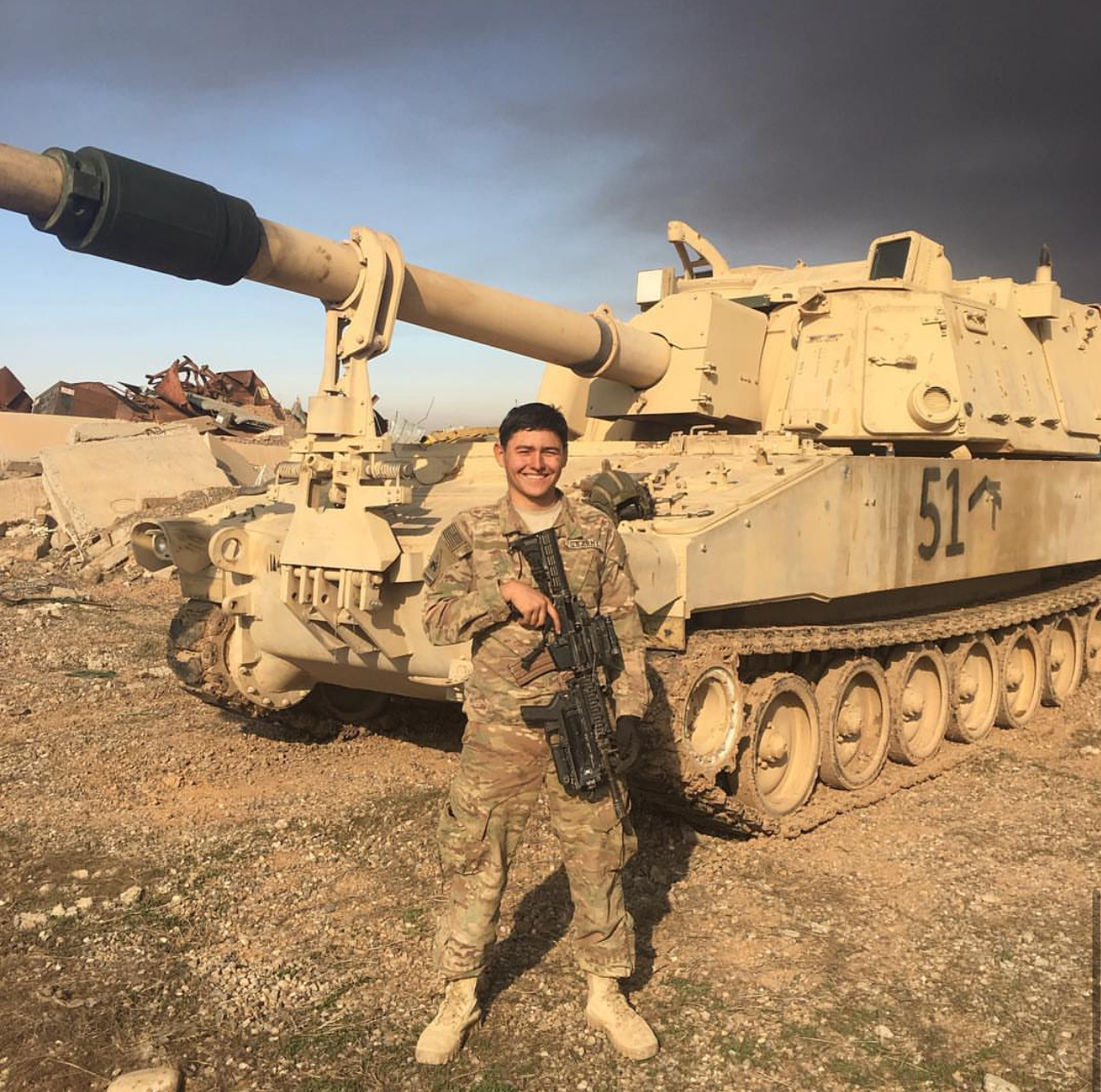 Barely 18 years old and weighing a scant 120 pounds, Rudy Becerra’s job in the United
States Army was to load a 100-pound, 155 mm artillery projectile into the tube of
an M109 Paladin Howitzer in the desert of Iraq. A few years later, he’s the commander
of the entire gun.
Barely 18 years old and weighing a scant 120 pounds, Rudy Becerra’s job in the United
States Army was to load a 100-pound, 155 mm artillery projectile into the tube of
an M109 Paladin Howitzer in the desert of Iraq. A few years later, he’s the commander
of the entire gun.
Not bad for a guy who was only 17 years old when he joined the military after helping his mother raise a family of eight, which sometimes ballooned to 11 with the addition of foster kids that they would take in.
The life experience odometer for Becerra has been spinning nonstop his entire life, but now the first-year medical student at UNT Health Fort Worth’s Texas College of Osteopathic Medicine is ready to put his substantial life experience to work as he prepares for his next mission.
Rudy Becerra from a decade ago might blush when he sees everything that he has accomplished during that time frame. But his family, and it’s a big one, wouldn’t be surprised.
“I was the second oldest of five kids,” Becerra said. “My mother adopted two more kids and then was a foster parent. There was a lot of responsibility, and that’s where I got a taste of leadership and putting others above my own. I had to make sure they were taken care of because the environment was always changing, but we were extremely close.”
Knowing that his family had limited resources, in 2015, at just 17 years old, Becerra
joined the Army to help pay for college. He was so young, in fact, his mom had to
sign a waiver for him to join. That didn’t slow his ambition, which was to be a medic,
but something else did.
“I didn’t pass the medic training,” Becerra said. “I’m thinking that I’m going to
conquer the world, and then I don’t pass.”
In the military, if you fail for a certain position, you aren’t just sent home, they find a new home for you in their ranks. For Becerra, that was the artillery. After his basic training, Becerra, at 18 years old, was deployed to Iraq as part of Operation Inherent Resolve in 2016 to support the Iraqi Defense Forces and NATO in the battle against ISIS. For five months, he lived in a tank.
“We were a four-man team and we were shooting 30 rounds a night to provide the Iraqi military the needed support,” Becerra said.
Becerra received the Combat Action Badge, which is awarded to soldiers who have personally engaged the enemy or been engaged by the enemy in ground combat, regardless of their Military Occupational Specialty (MOS). It recognizes soldiers who have been under direct fire or hit by enemy indirect fire, such as IEDs or RPGs.
Becerra, unfortunately, did see the ugly side of war as vehicles passed their position regularly, with the injured being brought back from the front lines.
“I told myself once I get out of Iraq, I was going to dedicate my life to helping to heal people.”
Becerra got out of Iraq in 2017, and at 19 was married. His time in the military wasn’t over yet, and his responsibility was growing. After Iraq, Becerra was promoted to Sergeant and then deployed to the Demilitarized Zone in Korea, better known as the DMZ. Despite its name, the DMZ is one of the most militarized positions in the world and also one of the most pressure-filled spots too.
Becerra, not old enough to drink, was now the commander of eight people and the “chief” of an artillery gun in Korea.
“It’s a very big responsibility, I had to learn as a young leader, but my personality really thrived in that,” Becerra said. “We conducted war simulations every month and were integrating with Korean soldiers into army units. I was managing US and Korean soldiers and learning different cultures, and I was just 21 years old.”
“I went from managing nobody to a group of eight people. I was responsible for their training and their safety. It’s different than a normal workspace, I know everything about them, their families, and I’m responsible for their safety, that was something I didn’t take lightly.”
After returning from Korea, Becerra’s time in the military was up. He received an honorable discharge and began college at the University of Texas at Austin in 2019. While beginning his pre-medicine track with his studies, Becerra also started working with True Heart Hospice. His inpatient visits still resonate with him today.
“You are providing that emotional support that they don’t get in a clinical setting,” Becerra said. “I was just there as a human being. I had one individual who I saw go through the different stages of grief before he passed, from anxiety to happiness. I saw the positive side of hospice — there were a lot of good times.”
Becerra also took away something else during his time working in hospice, perhaps something a little surprising for someone who had been in military conflicts.
“I used to be extremely scared of death,” Becerra said. “It helped me process my fear of death and that it is part of life. We have to be there for the people who are making that transition; it also makes you reflect on your own life. We only have a limited time here on earth, and we have to make the most of it, taking care of our community.”
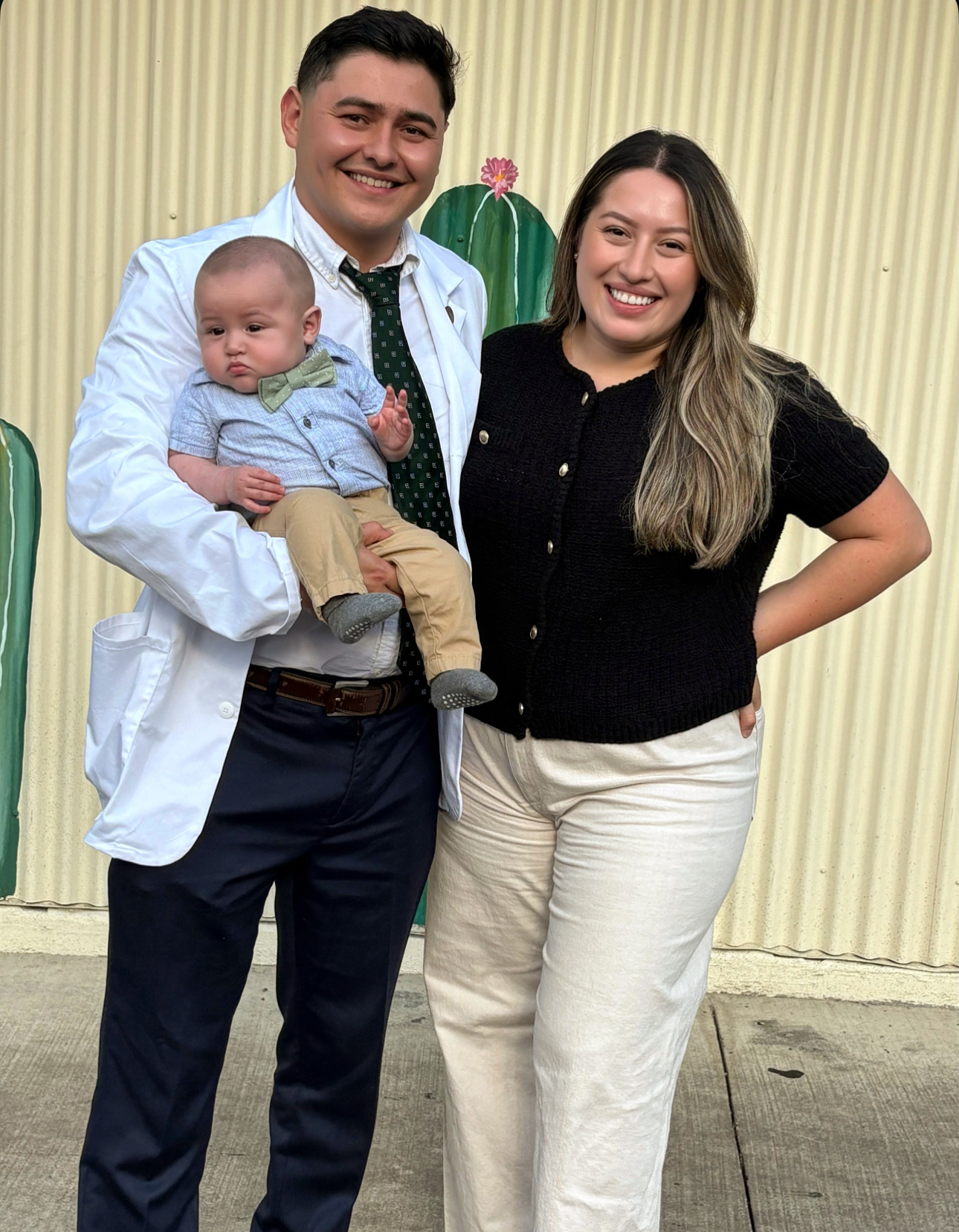 Becerra’s mentality of taking care of the community extended to his family at all
times. His mother-in-law moved in when she was diagnosed with cancer, along with his
sister-in-law, but taking care of his family is what Becerra is all about.
Becerra’s mentality of taking care of the community extended to his family at all
times. His mother-in-law moved in when she was diagnosed with cancer, along with his
sister-in-law, but taking care of his family is what Becerra is all about.
“I had to take care of my wife and provide her with emotional support at that time,” Becerra said. “It came back to me being a caretaker of a big family, and you learn to take responsibility, you learn to care for people, and that’s how I was raised, so it’s second nature at this point.”
He graduated in 2023 with a degree in computational biology, but didn’t apply for medical school until 2024. During the gap year, Becerra decided to get an MBA from SMU to better understand the business side of non-profit groups that he was working with during the year.
TCOM and osteopathic medicine matched perfectly with Becerra’s mindset. Not only was he motivated by his past failures as an army medic, but also by the loss of his aunt earlier in life to addiction.
“She was like a second mom to me, and seeing her struggle with addiction, that was the seed,” Becerra said. “The osteopathic philosophy and growing up and seeing people struggle with that, prescription medicine isn’t the answer. It encompasses the whole human experience, and I want to incorporate that into everything.”
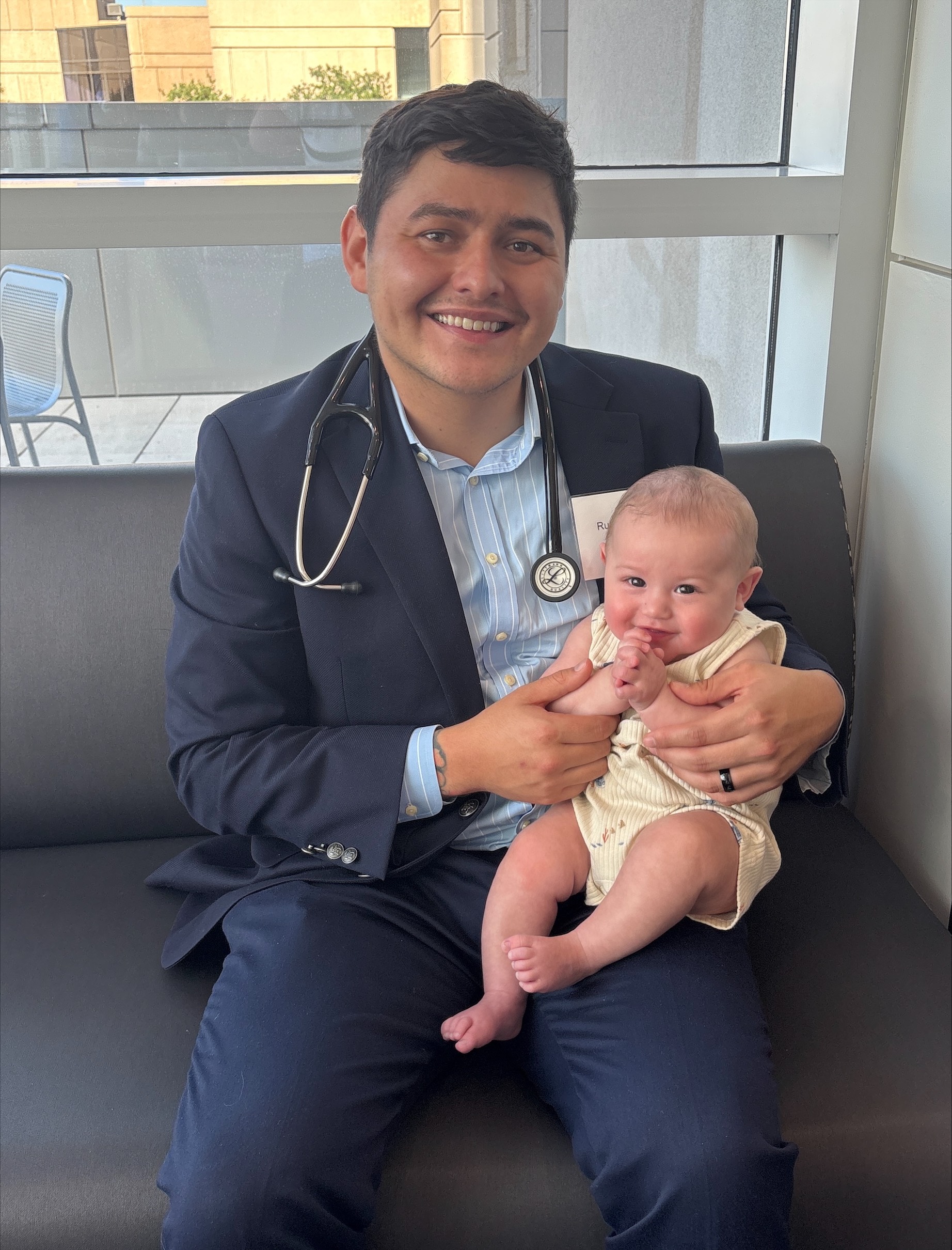 Becerra’s family recently got a little bigger as he is the father of a newborn, right
before he started medical school in July. He credits his adaptability in the military,
from having no air conditioning in Iraq to 0-degree weather in Korea, for preparing
him for the challenges of medical school and a newborn.
Becerra’s family recently got a little bigger as he is the father of a newborn, right
before he started medical school in July. He credits his adaptability in the military,
from having no air conditioning in Iraq to 0-degree weather in Korea, for preparing
him for the challenges of medical school and a newborn.
“It’s been a long journey, I feel almost a sense of relief now,” Becerra said. “My wife helps to keep me grounded, and having that family support to help me makes all of this worth it.”
Not bad for a guy who failed as an army medic a decade ago.