
North Texas Eye Research Institute Faculty and Staff
Faculty

Suchismita Acharya, PhD
Assistant Professor
Our current research is focused on expanding the chemical toolbox for neural signaling and anti-inflammation/anti-oxidant pathways to understand the mechanism of action of the disease pathology associated with glaucomatous optic neuropathy, Alzheimer Diseases, Ischemic stroke as well as angiogenesis. Our lab integrates medicinal chemistry, chemical biology, bio-engineering, and drug delivery via nanotechnology. We employ synthetic organic and organometallic chemistry to generate small molecule library for low throughput as well as high throughput screening (target based as well as phenotypic).

Abbot Clark, PhD
FARVO Professor
Abe Clark’s laboratory studies the cell and molecular mechanisms responsible for a variety of eye diseases, especially glaucoma. Glaucoma is a leading cause of irreversible vision loss and blindness in the world. Dr. Clark’s lab has discovered a number of new disease pathways involved in glaucomatous elevation of intraocular pressure. His lab also has identified novel neuroprotective therapies to protect specific retinal neurons, retinal ganglion cells, that are damaged in glaucoma, and also protect the optic nerve and visual centers in the brain. Abe currently mentors 9 graduate students and serves on the editorial board of 4 scientific journals. He has published over 190 peer-reviewed manuscripts and has been invited to present his scientific work at over 110 national and international scientific meetings.

Denise Inman, PhD
Associate Professor
My lab investigates the metabolic alterations associated with the pathogenesis of glaucoma. Mitochondria, the organelles responsible for generating energy and coordinating metabolism in the cell, show various signs of dysfunction prior to the degeneration that occurs in glaucoma. Also compromised are the cellular transporters that provide the raw materials for energy generation to the mitochondria. We are establishing ways to limit these changes in order to prevent glaucoma development.

Ankita Jaykumar, PhD
Assistant Professor
My lab investigates the metabolic alterations in the brain associated with the pathogenesis of cognitive dysfunction. Evidence including our recent work highlights the pivotal role of insulin in neuronal functions such as learning and memory. Indeed, dementia is recognized as a neuroendocrine disorder as it is referred to as Type 3 diabetes. Metabolic dysfunction largely due to dysregulation of endocrine signaling, becomes a high-risk factor for memory dysfunction. Although metabolic dysfunction in the brain precedes cognitive dysfunction, how neuronal endocrine signaling regulates brain function is poorly understood. As approximately half of those in the US above the age of 65 are either diabetic or prediabetic, understanding the mechanistic basis of endocrine signaling in the brain is of high urgency with a significant impact on the well-being of our aging society. Our previous work uncovered a molecular mechanism involving ‘WNK Kinases’ as key regulators of neuronal insulin signaling as well as memory. This finding opens a window of opportunity to investigate the mechanism underlying the synergistic relationship between metabolic dysfunction and cognitive disorders. To advance our understanding of neuronal metabolic regulation, we have developed an interdisciplinary research program that addresses mechanisms of age-based differences in neuroendocrine function and derangements that cause memory decline.
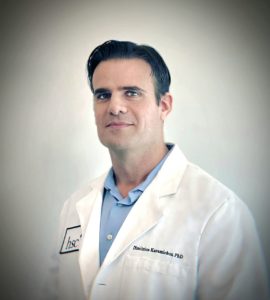
Dimitrios Karamichos, PhD
Executive Director & Endowed Chair
Lab Mission: Our goal is to discover, develop, and deliver novel therapies for the treatment of corneal trauma and diseases.
The lab is currently running several projects, including the discovery of novel biomarkers and therapeutic solutions for the diagnosis, management, and treatment of corneal fibrosis, keratoconus, and diabetic keratopathy. We have a strong interest in personalized medicine, particularly how factors such as sex, age, and disease severity influence corneal diseases.

Jayoung Kim, PhD
Assistant Professor
Our lab develops and studies innovative drug delivery systems with the following three major focus areas.
- Local drug delivery via 3D-printed, ocular device: We aim to develop polymer-based constructs (contact lens, artificial cornea) with appropriate drug release profiles specific to the applications concerning corneal disease.
- Hitchhiking-enabled, organ-specific drug delivery: We aim to develop hollow, polymeric microcapsules that serve as carriers of surface-adsorbed nanoparticles to target specific organs following systemic administration.
- Personalized drug delivery to breast tumor: We aim to enhance tumor delivery of a variety of nanoparticle platforms by addressing various phenotypic features that represent interpatient heterogeneity in breast cancer.

Raghu Krishnamoorthy, PhD
Professor, Pharmacology & Neuroscience, North Texas Eye Research Institute
Graduate Faculty Full Member
The major research emphasis is on understanding biochemical and molecular mechanisms underlying the etiology of glaucoma. Specific research interests are to understand the regulation of expression of the vasoactive active peptides, endothelins, and their receptors, which are thought to contribute to glaucomatous optic neuropathy. The endothelin (ET) system of vasoactive peptides (comprising of ET-1, ET-2 and ET-3) and their G protein coupled receptors (ETA and ETB receptors) have been found to be elevated in animal models of glaucoma. Corroborative findings from several laboratories have demonstrated that ET-1 acting through both vascular and cellular mechanisms produces neurodegenerative effects in glaucoma. ET-1 mediates these effect through activation of the ETA and ETB receptors, leading to optic nerve degeneration and retinal ganglion cell death. Our current projects address the role of endothelins in producing a decline in mitophagy in rodent models of glaucoma. The long-term goals are to develop endothelin receptor antagonists as neuroprotective agents for the treatment for glaucoma.
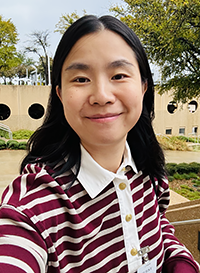
Xinyue Liu, PhD
Assistant Professor

Cameron Millar, PhD
Research Assistant Professor
Experienced eye researcher and educator, with both academic and industrial experience, committed to the investigation of ocular anterior segment physiology, aqueous humor dynamics, pharmacology, and glaucoma. Experienced with in vivo (live animal) and organ perfusion paradigms, as well as small animal research surgical techniques, in the following species: mouse, rat, rabbit, monkey, and bovine.

David Vumbaco, PhD
Director of Research
Dr. David Vumbaco is a sensory neuroscientist and research leader whose work bridges neuroscience, machine learning, and clinical medicine. As Director of Research at the North Texas Eye Research Institute (NTERI), he currently leads research under the Dementia Prevention Research Institute of Texas (DPRIT) and a novel collaboration between NTERI and Nursing's SANE program, leveraging the retina as a non-invasive diagnostic window through ML-driven algorithmic interpretation of retinal imaging. Prior to joining NTERI in 2025, Dr. Vumbaco served as Scientific Project and Alliance Manager at the Allen Institute for Brain Science, where he oversaw an approximately $30M portfolio of NIH- and endowment-funded programs in human cellular neuroanatomy, connectomics, and sensory neuroscience. He has secured over $15M in competitive funding from the many government, state and international agencies including the NIH, NSF, the Department of Defense, and the ESRF.
Hongli Wu, PhD
Assistant Professor
The central theme of my research is to understand the function of thiol-regulating enzymes and evaluate their therapeutic potential in eye diseases. Of primary interest is the age-related macular degeneration (AMD), the most common retinal disorder that affects 25 million people worldwide, yet its pathogenesis remains poorly understood. The following are our major projects:
Examine how retinal thiol redox dysregulation leads to AMD pathogenesis.
Characterize glutaredoxin 2 (Grx2), a thiol redox-regulating enzyme, knockout mice
as a new animal model for AMD.
Identify/screening Grx2 inducers from natural products for AMD treatment.