
Research Policies
HIERARCHY OF POLICIES
In a sponsored project, there are a number of different policies that may apply to your award. This includes the sponsor's terms, conditions and award policies; federal guidelines such as Uniform Guidance (2CRF200), state specific policies and guidelines; and institutional policies. When one policies contradicts another policy, which one should you abide by to ensure you're in compliance? Below is the hierarchy of policies that takes precedence and the general rule to follow.
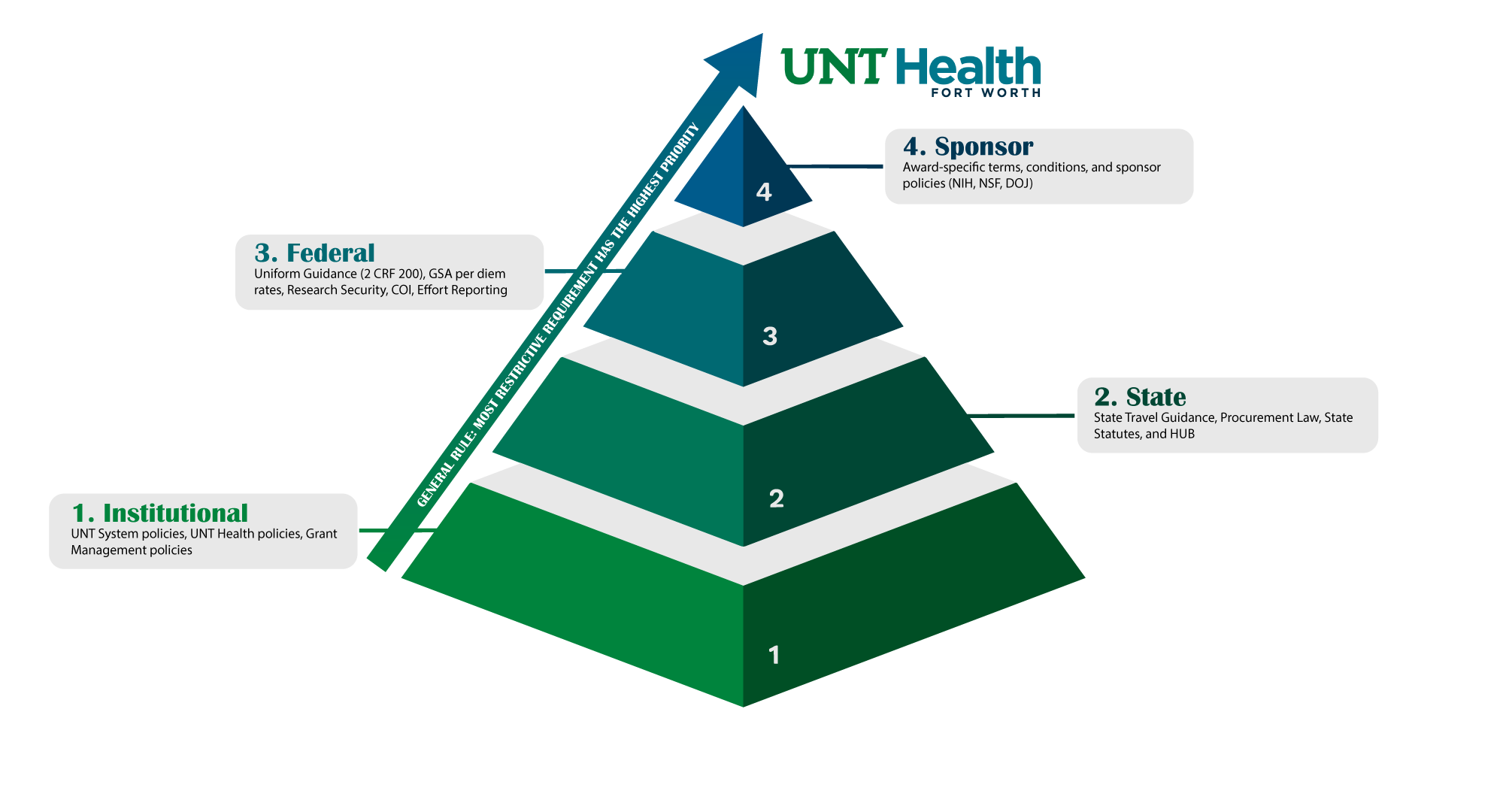
1. INSTITUTIONAL POLICIES
SYSTEM POLICIES
UNT Health is one of many campus that makes up UNT System. As a system, there are overarching policies that apply to all campuses. These policies will take precedence over the campus level policies. Certain functions, such as Human Resource (HR), Information Technology (IT) and Purchasing are centralized at the system level. Below are some of the UNT System policies that are applicable for sponsored projects:
UNT HEALTH POLICIES
UNT Health policies build upon UNT System policies and adds more details for processes that are unique to UNT Health compared to other UNT campuses. Below are the UNT Health policies related to sponsored projects:
You can find the travel guide and full list of UNT policies here: ALL POLICIESTRAVEL GUIDE
General Rule: Any institutional policies that are more restrictive will take precedence over other state, federal and sponsor policies. For example, if institutional policies require itemized receipts for actual employee meals reimbursement, that would take precedence over any state, federal or sponsor's policies that does not required an itemized receipt.
2. STATE POLICIES
State policies apply for any sponsored projects funded with state funds. State funds generally have more restrictions then general university funds, thus state policies often override university policies as the most restrictive policy. The Texas Comptroller of Public Accounts manages the Texas Grant Management Standards (TxGMS), which outlines financial administration rules, cost principles and audit requirements. Many of these policies closely align with federal uniform guidance (2 CRF200) while some are specific to the state of Texas.
Travel
Travel policies for projects with state funds may be different from institutional
and federal award policies. Below are some state travel policies that are important
to understand.
Statewide Single Audit
Each year, the State Auditor's Office (SAO) conducts a Statewide Single Audit for
the State of Texas. For the federal compliance portion of the Statewide Single Audit,
the State Auditor's Office audits the Schedule of Expenditures of Federal Awards (SEFA)
in relation to the ACFR. The Comptroller prepares the SEFA by using the self-reported
SEFA data.
Federal Portion of Statewide Single Audit Report for the Year Ended August 31, 2025:
Single Audit Report
Summary of Federal Expenditures by State Agency: SEFA
3. FEDERAL POLICIES
Federal awards encompass a wide variety of scientific research. As a result, the Office
of Management and Budgets (OMB) created the Uniform Guidance (codified at 2 C.F.R
Part 200) to help simplify the rules, cut waste or extra work for people who get federal
funds and provide administrative, cost and audit rules.
Instead of creating specific rules that are too specific or rigid, Uniform Guidance
provides a set of guiding cost principles that are applied to every federal federal.
Below are the cost principles that you should know.
When In Doubt: Document your basis for why the expense was allowable and allocable to the award. Would it pass the Prudent Person test? Why is it necessary and reasonable for the performance of your federal award?
The federal government has its own travel regulations. The U.S. General Services Administration (GSA) sets the daily lodging (excluding tax) and meals and incidental expense (M&IE) for travel within the United States. Otherwise known as the per diem rate, it sets the standard allowable amount for lodging and meals based on the geographical location. When international travel is required, the U.S. Department of State sets the Foreign Per Diem Rate by location. See below for details regarding travel regulations on federal awards:
4. SPONSOR'S POLICIES, TERMS & CONDITIONS
Each sponsor may have specific policies, terms and conditions that may add or remove some layer of state and federal regulations based on the type of award. The terms & conditions listed in your award notification details the specific terms that was agreed upon.
Below are examples of several sponsors and their administrative policies that determines when prior approval is necessary.
Prior Approval for Budget Changes: When in doubt, reach out to an UNT Health OSP Post-Award staff. Post-Award may advise you to reach out to your specific award program officer for additional clarification.