
Texas Center for Performing Arts Health History
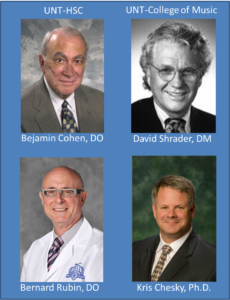 Following the Applications of Music & Medicine conference at UNT in 1996, Dr. Ben
Cohen, then Executive Dean for UNT Health, along with Dr. David Shrader, then Dean
of the UNT College of Music, encouraged and supported the development of a shared
center between the Denton and Fort Worth campuses. Then named the Texas Center for
Music & Medicine, this collaborative project received official approval in 1999 by
the UNT Deans Counsel and the Office of the Provost and Vice President for Academic
Affairs.
Following the Applications of Music & Medicine conference at UNT in 1996, Dr. Ben
Cohen, then Executive Dean for UNT Health, along with Dr. David Shrader, then Dean
of the UNT College of Music, encouraged and supported the development of a shared
center between the Denton and Fort Worth campuses. Then named the Texas Center for
Music & Medicine, this collaborative project received official approval in 1999 by
the UNT Deans Counsel and the Office of the Provost and Vice President for Academic
Affairs.
As founding Co-Directors, Drs. Kris Chesky and Bernard Rubin spearheaded specific initiatives including the establishment of a musicians’ clinic at the Health Sciences Center, the Health Promotion in Schools of Music project (www.unt.edu/hpsm), and the development of new undergraduate and graduate courses for music majors. Together they started specific projects to facilitate interdisciplinary and integrative research in order to create engagement opportunities for graduate students in music, audiology, psychology, and engineering. One of the first projects was a master’s thesis by a public health student of musculoskeletal problems among piano players – resulting in a published research article that is still widely referenced in the performing arts medicine literature. Interests expanded and led to numerous research projects conducted by students majoring in performance, conducting, piano, composition, music education, jazz studies, audiology, engineering technology, electrical engineering, computer science engineering, psychology, behavioral medicine, medicine, and physical therapy. Outcomes in the forms of theses, dissertations, professional papers, and post-doc fellowships represent the origins for several sustained research directions at UNT.
In 2014, the UNT Office of Academic Affairs and the Executive Council of Centers/Institute
Directors formally reviewed the Texas Center for Music & Medicine “very favorably”
and praised the center’s overall productivity, cross-college and cross-campus collaborations,
research producti vity, graduate student involvement, outreach, and positive branding for UNT. The review
also underscored the significance of this work on national and state education policies.
Most notable is the direct influence of UNT on the ratification of the first-ever
national health and safety accreditation standard that, as of 2012, directs over 600
tertiary schools of music in the USA to ensure that student musicians are aware, knowledgeable,
and competent to respond to health and safety issues related to learning and performing
music. Similarly, in 2013, the Texas Education Agency ratified new Texas Essential
Knowledge and Skills (TEKS) learning objectives designed to ensure that all middle
and high school band, choir, and orchestra students explore, understand, and apply
health and wellness concepts related to musical practice. The review also recognized
research awards to both undergraduate and graduate students, internal UNT awards for
innovative course designs, numerous invitations for conference presentations and keynote
addresses, and in 2010, a high profile “Safe in Sound” award from the National Institutes
of Occupational Safety and Health. The review also highlighted innovative research
related to mental health of musicians, pianists’ anthropometrics and ergonomics, biomechanics
of brass and woodwind instruments, epidemiologic profiles of musician populations,
direct and real-time sound level measurement and analysis, intraoral pressure measurement,
musician earplug testing, hearing aid testing for music, health education models,
and applications of human performance engineering and sports psychology to the performing
arts.
vity, graduate student involvement, outreach, and positive branding for UNT. The review
also underscored the significance of this work on national and state education policies.
Most notable is the direct influence of UNT on the ratification of the first-ever
national health and safety accreditation standard that, as of 2012, directs over 600
tertiary schools of music in the USA to ensure that student musicians are aware, knowledgeable,
and competent to respond to health and safety issues related to learning and performing
music. Similarly, in 2013, the Texas Education Agency ratified new Texas Essential
Knowledge and Skills (TEKS) learning objectives designed to ensure that all middle
and high school band, choir, and orchestra students explore, understand, and apply
health and wellness concepts related to musical practice. The review also recognized
research awards to both undergraduate and graduate students, internal UNT awards for
innovative course designs, numerous invitations for conference presentations and keynote
addresses, and in 2010, a high profile “Safe in Sound” award from the National Institutes
of Occupational Safety and Health. The review also highlighted innovative research
related to mental health of musicians, pianists’ anthropometrics and ergonomics, biomechanics
of brass and woodwind instruments, epidemiologic profiles of musician populations,
direct and real-time sound level measurement and analysis, intraoral pressure measurement,
musician earplug testing, hearing aid testing for music, health education models,
and applications of human performance engineering and sports psychology to the performing
arts.
Together, the research, education, and engagement activities associated with the Texas
Center for Music & Medicine have directly influenced how schools of music across the
country educate student musicians. The center continues to influence the growing recognition
and evolution o f performing arts medicine as a special-interest topic within various disciplines
including music education, medicine, audiology, speech-language pathology, physical
therapy, sports medicine, psychology, occupational safety and health, and public health.
f performing arts medicine as a special-interest topic within various disciplines
including music education, medicine, audiology, speech-language pathology, physical
therapy, sports medicine, psychology, occupational safety and health, and public health.
With Dr. Rubin’s departure from UNT Health in 2010, the intercampus relationships were temporarily disrupted and the workload was shifted almost entirely to the College of Music and collaborators on the UNT Denton campus. In 2014, UNT Health hired Dr. Sajid Surve, a physician with extensive clinical experience in performing arts medicine and a strong background in education. Since, Drs. Surve and Chesky have worked to renew, reaffirm, and expand the original UNT and UNT Health partnership in order to meet the rapidly evolving needs of the performing arts community on multiple fronts and levels.
In response, leadership at UNT and UNT Health agreed in 2015 to change the center’s name to the Texas Center for Performing Arts Health to reflect the expanded scope. Together with the rapidly developing opportunities associated with the educational policies noted above and the ever-increasing number of interested graduate students, the Texas Center for Performing Arts Health will focus on expanded education, research, and clinical outreach activities. Together, these projects will leverage faculty expertise and resources from both campuses in ways that strengthen UNT’s public image and branding, regional and national influence, scientific and clinical rigor, educational offerings, and ability to attract interest of funding agencies for new and exciting engagements activities.