
Dallas–Fort Worth Community Profile
Dallas–Fort Worth Community Profile
Community Health Landscape by Cities in DFW Region
The Dallas–Fort Worth (DFW) region encompasses ten counties and serves as one of the largest metropolitan areas in the United States. Dallas, Fort Worth, and Arlington are the region’s central anchor cities, which are surrounded by fast-growing suburban communities.
This page provides a comprehensive overview of the DFW area’s demographics, social, and economic characteristics, using data from the U.S. Census Bureau. It explores population size, race and ethnicity, gender distribution, age groups, and household composition to highlight the region’s demographic variability. Additional insights into income, poverty levels, and educational attainment offer valuable context for shaping policies and offer valuable context for shaping policies and programs that advance health outcomes across the region.
Population
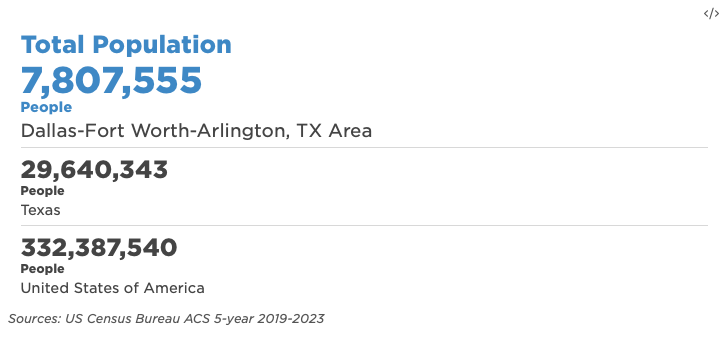
Dallas-Fort Worth also known as DFW is now the 4th largest metropolitan area in the US. It is projected to surpass Chicago and be the 3rd by 2030. Learn More
(Hot tip: Click on New York & LA using the legend down below to further appreciate population rise in Dallas-Fort Worth Metroplex)
Race & Ethnicity
Households
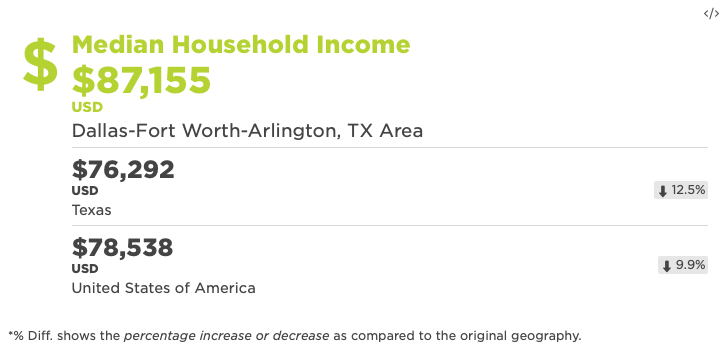
Follow this link to see how the median income of DFW households is distributed through the metropolitan region. You can toggle between maps and mouse over regions to view the median household incomes of places (cities), neighborhoods, zip codes and census tracks. Learn more
Education Attainment
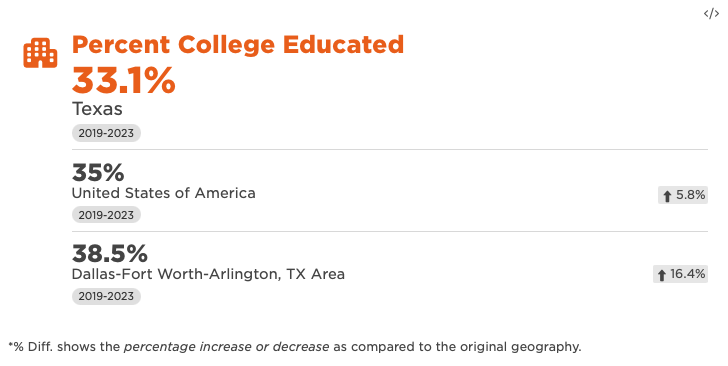
Every member of our community should have the chance to live a healthy life. Click on the link below to find more information about the demographic characteristics such as languages spoken, immigrant population, veteran status, and people with disabilities are all important to understand the unique needs of our community.