
What is a Community Garden?

According to the American Community Garden Association, a community garden is “any piece of land gardened by a group of people.” They vary in scope, location and what they grow. For example a community garden can:
- Be located just about anywhere (urban, rural, suburban)
- Grow a variety of vegetation (vegetables, flowers, herbs, etc.)
- Be individual or communal plots
- Be owned and operated by all types of organizations such as schools, universities, neighborhoods, hospitals and churches
Benefits of a Community Garden?
Community gardens have numerous benefits depending on the goal and scope of each garden. Benefits include:
- Promoting health and wellness
- Providing a sense of community
- Educating people about food production and nutrition
- Serving the community through food donation
- Beautifying spaces and reducing the heat island effect (occurs in built environments where the temperature is higher than in rural surroundings)
Timeline (2012-Present)
- October 2012– Community Garden Subcommittee was established to lay the groundwork for a community garden. We researched space on campus, approached Facilities Management with a proposal, and created a campus-wide survey to assess the interest and support amongst students and staff.
- April 2013 – Community Garden Assessment Survey was administered. We received 216 responses with 97% of respondents indicating their support for the garden.
- Summer 2013 – The subcommittee completed site visits to two gardens in the region in order to learn best practices and lessons.
- October 2013 – We received funding from the Sustainability Committee in the initial amount of $8,000.
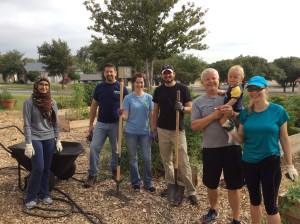
- February 2014– Forty volunteers came together on Build Day in order to build the plots, fill them with soil, and mulch the paths. Students and staff were able to start gardening. Donations were received from several businesses and organizations throughout Fort Worth.
- March 2014 – The garden’s first Planting Day included a day to plant the spring crop together and learn gardening techniques from a master gardener.
- May 2014 – Our first donation to a local food bank, North Inter-Community Agency (NICA), occurred as part of our service to the community.
- October 2014 – The garden added picnic tables which were upcycled from used pallets as well as rain barrels in order to further accomplish our sustainability goals through the garden. The Sustainability Committee granted another $6000 to the garden to expand.
- February 2015– Forty five volunteers including community members came together to add additional plots for the garden’s second Build Day. Three compost bins were added to the garden.
- March 2015 – The garden’s second Planting Day included an educational presentation at the garden by the Texas A&M AgriLife Extension Tarrant County.
- September 2015 – Completed the build out of the garden by adding the last 8 plots with the help of 45 volunteers. This gave us a total of 35 4’x12’ plots at the garden.
- October 2015 – Painted the wall mural with the help of 13 volunteers. See the time lapse video here.
- March 2016– Third Annual Planting Day on March 22nd. We had 30 people attend, and we started off the year’s donations with a 20 lb. donation to NICA.
- 2017-Present - The garden continues to thrive with fruit trees, pollinator areas, an herb bed, and common growing areas in addition to the 35 garden beds.
Financing the Garden
The UNT Health Community Garden has received most of its financing through the Sustainability Committee which receives funds from a student fee called the Environmental Services Fee. The fee is intended to advance sustainable practices on campus. The garden has asked for funds on two separate occasions and has received $14,000 from the committee. Gardeners also pay dues each year ($40 per year per plot). In addition to the committee funds and dues, we have received in-kind and monetary donations from various businesses and organizations. For example, St. Emilion French Restaurant, which borders the garden, donated $500 in 2014 to support the garden. In exchange, they managed a plot in 2014 and were able to use the fresh produce in their restaurant. Below is a brief summary of what each organization donated and the estimated monetary value. We continue to ask businesses for donations as the garden grows and adds other features such as composting. We recognize contributions on a large sign at the garden, on printed material, on the garden’s website, and in a letter from the UNT Health Foundation. Donations are eligible for tax exemption.
- Archie’s Gardenland – compost, mulch, plant sets, fertilizer (~$1000 worth)
- Calloway’s Nursery – plant sets (~$200 worth)
- Freehling’s Tree Service – mulch (~800 worth)
- Marshall Grain Co. – seeds, plant labels (~$50 worth)
- Silver Creek Materials – soil; they have agreed to give us soil whenever we need it (~$1800 worth to date)
- St. Emilion Restaurant – $500 monetary support
- Texas A&M AgriLife Extension Tarrant County – plant sets (~$240 worth)
- UNT Health Facilities Management – labor in building the tool shed, arbor and compost bins (~$1500 worth)