The Office of Management and Budget's (OMB) Circular A-21 "Cost Principles for Educational Institutions" and the "Uniform Administrative Requirements,
Cost Principles and Audit Requirements for Federal Awards," 2 CFR Part 200, Section 200.430, Compensation-Personal Services (UG) is the federal government's cost principles for colleges and universities. It
defines what costs are allowable and allocable to federal grants and other assistance
agreements.
OMB (A-21, Section J.10 or UB, Section 200.430) sets criteria for acceptable methods of charging salaries and wages to federally
sponsored projects and requires a payroll distribution system that directly charges
salaries to appropriate projects
In addition, OMB requires that institutions develop a mechanism to determine or confirm
how individuals actually expend effort during a specified time period. These effort
reports must be performed on a regular schedule and must be certified by individuals
who have first-hand knowledge of 100% of the employee's compensated activities. The
Principal Investigator is required to certify the effort report for all project employees.
In fiscal year 2014, federal awards represented approximately 77% of total grant and
contract award activity at UNT Health. Salary expense represents the largest direct
cost component on these projects.
In recent years, the federal government and its auditors have become much more active
in their review of effort reporting requirements, and a number of universities have
received large audit disallowances as a result. Recent cases are audit disallowances
are:
- Northwestern University paid $5.5 million to settle issues related to problems with
effort reporting, on a contracts and grants base of $325 million;
- South Florida returned $4.1 million to the federal government to settle a number of
charging issues, including effort reporting;
- University of California paid a total of $2.1 million to settle an NIH salary cap
limitation disallowance for the period July 1, 1995, through June 30, 2002.
An Effort Reporting System must provide records on how individuals participating in
federally funded sponsored agreements actually spend their time. Because the federal
government mandates effort reporting, it is incumbent upon institutions that received
federal funding to maintain accurate and auditable systems and records.
Documentation on how individuals spend time on federally sponsored projects is subject
to federal audit and can be cause for institutional or individual disallowances.
Institutional disallowances can result if:
- The effort report was certified by an individual who would not have reasonable knowledge
of time a project employee spends on the project;
- The effort report does not encompass all of the activities performed by the employee
under the terms of their employment;
- The levels of effort reported do now appear reasonable, given the responsibilities
of the individual or the actual time spent working on the project;
Individual disallowances can result if:
- The effort report certified by the individual is found to be falsified;
- The levels of effort reported do not appear reasonable
As evidenced above, federal audit disallowances can result in serious financial penalties
for institutions. In addition, criminal charges may be brought against an individual
certifying to falsified effort. Current audit plans for federal auditors include effort
reporting as a specific audit focus.
You can find UNT Health's time and effort policy in PolicyTech under 8.101 Effort
Reporting.
Policy 8.101
During the effort certification period, Principal Investigators (PIs) and faculty
receive up to three email notifications informing them that their effort statement
is ready for certification.
If, after the close of the effort certification period, a PI or faculty member has
not certified their effort or project statements, the Research Financial Compliance
team will review and initiate the following escalation process if their effort is
in fact ready to certify:
Initial escalation: An email will be sent to the direct supervisor listed in the employee’s
ePAR, with the Director of Grant Accounting and Fiscal Compliance copied.
Two-week follow-up: If the issue is not resolved within two weeks, the matter will
be escalated to the department chair, with the supervisor and the Director of Grant
Accounting and Fiscal Compliance included.
Further escalation: If the issue remains unresolved, it will be escalated to the Dean,
copying the Vice President for Research & Graduate Studies and the Senior Associate
Vice President for Research Finance & Administration.
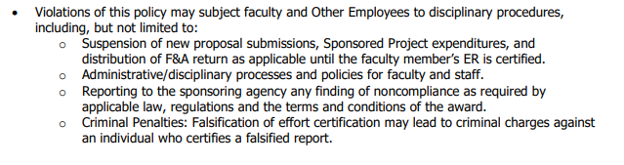
Final action: If no action is taken by the Dean, the university’s violation policy
will be implemented. See 8.101 for details:
During the life of an NSF or NIH award, the PI must notify the Office of Sponsored
Programs (OSP) when the PI is going to be temporarily absent from the project (three
months or less.) For PI absences longer than three months, the University must obtain
prior sponsor approval and notify the sponsor at least 30 days before the PI’s departure.
In both cases OSP is required to notify the grantee agency of arrangements that have
been made for the conduct of the project during the PI’s absence, so the PI must provide
this information to OSP. Prior sponsor approval is also required for significant reductions
(generally 25% or more) of the PI’s effort on the project (including periods under
a no cost extension.) These requirements also apply to co-PIs and, on NIH awards,
to senior or key personnel designated by NIH in the Notice of Award.
It is the PI’s responsibility to be aware of each key person’s effort commitments
to communicate any inability to meet those commitments to OSP to ensure that any necessary
sponsor approvals of their reduced efforts are obtained.
