
Financial Health
Financial health involves having adequate financial resources that support day-to-day living and long-term stability. It includes access to steady income, manageable debt, savings, and the resources to cover emergencies, healthcare, housing, education, and basic needs.
Examples: Median household income, % with employer-provided health insurance, % below poverty level, % experiencing housing insecurity.
Financial Health Indicators

SNAP, or the Supplemental Nutrition Assistance Program, provides food assistance to eligible low-income individuals and families through monthly benefits on an Electronic Benefits Transfer (EBT) card, usable at participating stores to buy food. Administered by the USDA‘s Food and Nutrition Service (FNS), SNAP determines eligibility at the state level. Eligibility is based on household income, assets, and family size, with benefits varying accordingly.
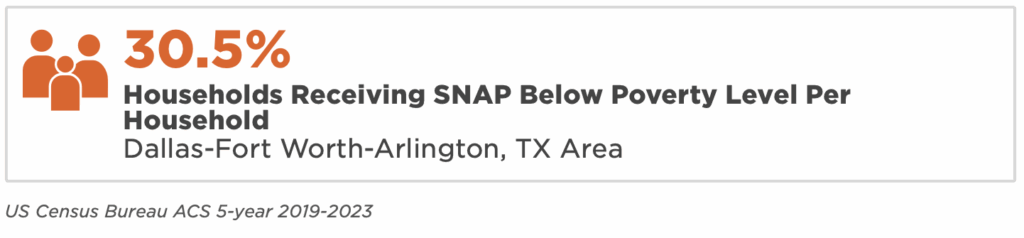
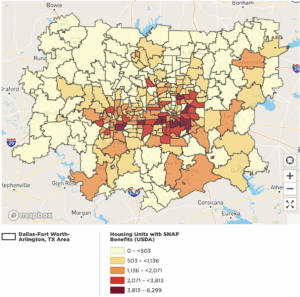
Follow the thumbnail to Housing Units with SNAP Benefits. You can toggle between maps and mouse over regions to view the median household incomes of places (cities), neighborhoods, zip codes and census tracks.

The Census Bureau uses a set of money income thresholds that vary by family size and composition to determine who is in poverty. If a family’s total income is less than the family’s threshold, then that family and every individual in it is considered in poverty.
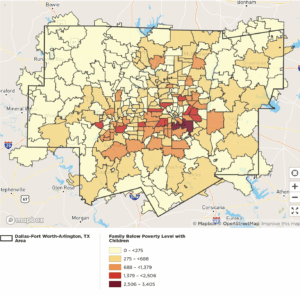
Follow the thumbnail to see how families below poverty level with children within DFW households. You can toggle between maps and mouse over regions to view the median household incomes of places (cities), neighborhoods, zip codes and census tracks.
Individuals with high subjective debt—meaning they feel more financially burdened than others—reported an 11.7% increase in perceived stress symptoms and a 13.2% increase in depressive symptoms, compared to the average.
People living in poverty face higher rates of nearly every negative health outcome, from chronic illness to injury to early death. In the most low-resourced U.S. communities, life expectancy is often 10–15 years lower than in the wealthiest neighborhoods. The risk of cardiac arrest is 30–80% higher in neighborhoods with the lowest socioeconomic status compared to the wealthiest areas.

Excessive housing costs often force families to make trade-offs between rent, food, healthcare, and other essential needs. For uninsured residents, this financial burden can significantly reduce access to preventive care and increase the risk of untreated chronic conditions, highlighting the connection between economic stability, housing security, and health outcomes.
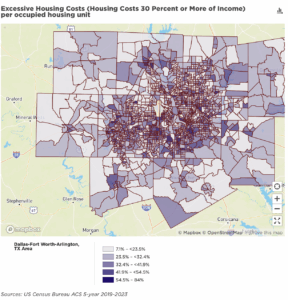
Follow the thumbnail to see the excessive housing cost within DFW households. You can toggle between maps and mouse over regions to view the median household incomes of places (cities), neighborhoods, zip codes and census tracks.

In the U.S., people with low or medium job skills who were unemployed had a 2.4x higher risk of dying than those who were employed.
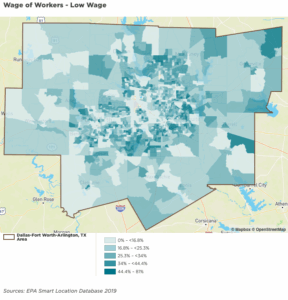
Follow the thumbnail to see wage of workers – low wage DFW households is distributed through the metropolitan region. You can toggle between maps and mouse over regions to view the median household incomes of places (cities), counties, zip codes and census tracks.